 Get New Issue Alerts
Browse Archive
- Vol 44 Issue 1
- Vol 43 Issue 4
- Vol 43 Issue 3
- Vol 43 Issue 2
- Vol 43 Issue 1
- Vol 42 Issue 4
- Vol 42 Issue 3
- Vol 42 Issue 2
- Vol 42 Issue 1
- Vol 41 Issue 4
- Vol 41 Issue 3
- Vol 41 Issue 2
- Vol 41 Issue 1
- Vol 40 Issue 4
- Vol 40 Issue 3
- Vol 40 Issue 2
- Vol 40 Issue 1
- Vol 39 Issue 4
- Vol 39 Issue 3
- Vol 39 Issue 2
- Vol 39 Issue 1
- Vol 38 Issue 4
- Vol 38 Issue 3
- Vol 38 Issue 2
- Vol 38 Issue 1
- Vol 37 Issue 4
- Vol 37 Issue 3
- Vol 37 Issue 2
- Vol 37 Issue 1
- Vol 36 Issue 4
- Vol 36 Issue 3
- Vol 36 Issue 2
- Vol 36 Issue 1
- Vol 35 Issue 4
- Vol 35 Issue 3
- Vol 35 Issue 2
- Vol 35 Issue 1
- Vol 34 Issue 4
- Vol 34 Issue 3
- Vol 34 Issue 2
- Vol 34 Issue 1
- Vol 33 Issue 4
- Vol 33 Issue 3
- Vol 33 Issue 1
- Vol 32 Issue 4
- Vol 32 Issue 3
- Vol 32 Issue 2
- Vol 32 Issue 1
- Vol 31 Issue 4
- Vol 31 Issue 3
- Vol 31 Issue 2
- Vol 31 Issue 1
- Vol 30 Issue 4
- Vol 30 Issue 3
- Vol 30 Issue 2
- Vol 30 Issue 1
- Vol 29 Issue 4
- Vol 29 Issue 3
- Vol 29 Issue 2
- Vol 29 Issue 1
- Vol 28 Issue 4
- Vol 28 Issue 3
- Vol 28 Issue 2
- Vol 28 Issue 1
- Vol 27 Issue 4
- Vol 27 Issue 3
- Vol 27 Issue 2
- Vol 27 Issue 1
- Vol 26 Issue 4
- Vol 26 Issue 3
- Vol 26 Issue 2
- Vol 26 Issue 1
- Vol 25 Issue 4
- Vol 25 Issue 3
- Vol 25 Issue 2
- Vol 25 Issue 1
- Vol 24 Issue 4
- Vol 24 Issue 3
- Vol 24 Issue 2
- Vol 24 Issue 1
- Vol 23 Issue 4
- Vol 23 Issue 3
- Vol 23 Issue 2
- Vol 23 Issue 1
- Vol 22 Issue 4
- Vol 22 Issue 3
- Vol 22 Issue 2
- Vol 22 Issue 1
- Vol 21 Issue 4
- Vol 21 Issue 3
- Vol 21 Issue 2
- Vol 21 Issue 1
- Vol 20 Issue 4
- Vol 20 Issue 3
- Vol 20 Issue 2
- Vol 20 Issue 1
- Vol 19 Issue 4
- Vol 19 Issue 3
- Vol 19 Issue 2
- Vol 19 Issue 1
- Vol 18 Issue 4
- Vol 18 Issue 3
- Vol 18 Issue 2
- Vol 18 Issue 1
- Vol 17 Issue 4
- Vol 17 Issue 3
- Vol 17 Issue 1
- Vol 16 Issue 4
- Vol 16 Issue 3
- Vol 16 Issue 2
- Vol 16 Issue 1
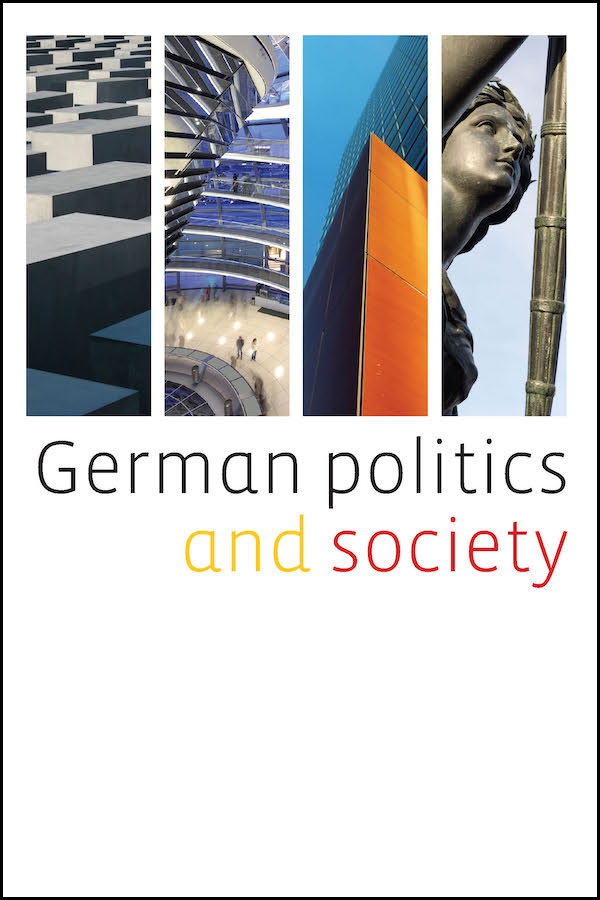
German Politics and Society
ISSN: 1045-0300 (print) • ISSN: 1558-5441 (online) • 4 issues per year
Volume 31 Issue 3
Latent but Not Less Significant: The Holocaust as an Argumentative Resource in German National Identity Discourse
There seems to be a wide consensus in the academic community that the Holocaust is gradually losing significance in the German public. This development is clearly reflected in public elite discourse on national identity, where “Holocaust-centered memory” has ceased to be hegemonic. In the literature, several interpretations and reasons have been presented to explain this development. This paper contributes to the debate by arguing that the declining presence of Holocaust-centered arguments in intellectual elite discourse on national identity is due to a new consensual idea of German nationhood. Based on an event-oriented discourse analysis of more than 800 articles in opinion-leading newspapers, journals and magazines covering a period of more than twenty years, I argue that in national identity discourse, the Holocaust has never been—as is usually assumed—a blockade to displays of national identity in general, but only to a specific interpretation of the German nation as a Volk and as an exclusionist culture nation. By contrast, the idea of nationhood that dominates in the German public sphere today, the civic nation model, has never invoked Holocaust-centered counter-arguments—not even in the Historikerstreit in the 1980s. Thus, over the past three decades, the way national identity discourse has operated might have changed less than had often been assumed. The central argument of this paper is that the Holocaust has become a “latent”—but not a less consequential—argumentative resource.
The Usage of Online Collaboration Platforms by Parties: Strengthening the “Party on the Ground” or the “Party in Central Office”?
Facing linkage problems, parties in Germany have started to respond to a changing media environment by reforming their internal structures of opinion forming and decision making, inter alia reacting to the rise of the social web and the successes of the Pirate Party whose party organization is to a large extent “digitalized”. Whether and how established parties implement and adapt Internet tools, i.e., whether these could contribute to more participation of the “party on the ground” or whether they strengthen the “party in central office” is the focus of this article. The case study on the employment of an online platform for drafting a motion for the party convention of the German Social Democrats in December 2011 reveals that the “party in central office” controlled the online procedure as well as the processing of the results to a remarkable extent—thereby constraining the participatory potential of the tool. At the same time, the case study indicates a quality of online collaboration platforms that might limit the instrumentalization of these tools by the party elites in the long run and possibly re-empower the “party on the ground.”
Domestic Constraints, German Foreign Policy and Post-Conflict Peacebuilding
Since the end of the Cold War, Germany has assumed a greater profile in addressing global security concerns. This article analyzes the evolution of Germany's approach to peacebuilding in the post Cold War era. It argues that while Germany could play a unique and important role in such missions, it has largely demurred. The muted quality of German leadership in international peacebuilding reveals a foreign policy role identity that remains circumscribed by a culture of restraint (Kultur der Zurückhaltung). From a constructivist perspective, this “culture of restraint” acts as a cognitive map for political leaders and policy makers, privileging a set of norms that guide policy-making. Peacebuilding missions present opportunities for Germany to operationalize the most fundamental tenets undergirding Germany's postwar foreign policy identity: the preference to cooperate with other states through multilateral institutions, the use of economic instruments to obtain foreign policy goals, and support for supranational institutions to address global problems. But such opportunities are not seized due to the absence of political elite consensus, inter-party, and inter-ministerial dissensus, institutional fragmentation and insufficient material support for international peacebuilding endeavors.
An Interview with Alice Schwarzer on Leni Riefenstahl
Alice Schwarzer’s name is synonymous with the second-wave women’s
movement in West Germany, and when she picks a fight, the odds are a
shouting match will follow. Admired by some, reviled by others, West Germany’s
best-known feminist has often used controversy to amplify the
activist journalism she has pursued since the late 1960s. She is opinionated,
combative, and unpredictable—attributes all reflected in her 1999 essay on
Leni Riefenstahl, which the interview below revisits. Her sympathetic portrayal
of the filmmaker met with criticism, which is certainly consistent with
the affinity toward ambivalence Schwarzer has demonstrated throughout
her career as an author, activist and talk show celebrity.
The German Economy and East-Central Europe: The Development of Intra-Industry Trade from Ostpolitik to the Present
Over the past decade Germany has had one of the most successful
economies in the developed world. Despite the ongoing Euro crisis unemployment
has fallen below 7 percent, reaching its lowest levels since German
reunification in 1990. Germany’s youth unemployment is among the
lowest in Europe, far beneath the European average.1 One of the most
important engines of the German economy today, and in fact throughout
the twentieth and twenty-first centuries, has been its export sector. As Ludwig
Erhard, West Germany’s Economics Minister during the Wirtschaftswunder
of the 1950s remarked: “foreign trade is quite simply the core and
premise of our economic and social order.”2 According to various estimates,
today exports and imports of goods and services account for nearly a half of
German GDP—up from only a quarter in 1990. Germany is one of only three
economies that do over a trillion dollars worth of exports a year, the other
two being the United States and China.
Book Reviews
Myra Marx Ferree, Varieties of Feminism: German Gender Politics in Global Perspective (Palo Alto: Stanford University Press, 2012)
Reviewed by Angelika von Wahl
K. Michael Prince, War and German Memory: Excavating the Significance of the Second World War in German Cultural Consciousness (Lanham: Lexington Books, 2009)
Reviewed by Richard Boffey
Shulamit Volkov, Walther Rathenau. Weimar’s Fallen Statesman (New Haven: Yale University Press, 2012)
Reviewed by Sabine von Mering
Quinn Slobodian, Foreign Front: Third World Politics in Sixties West Germany (Durham: Duke University Press, 2012)
Reviewed by Anna von der Goltz
Mary Fulbrook, A Small Town Near Auschwitz: Ordinary Nazis and the Holocaust (Oxford: Oxford University Press, 2012)
Reviewed by Richard Boffey
Lily Gardner Feldman, Germany’s Foreign Policy of Reconciliation: From Enmity to Amity (Lanham: Rowman and Littlefield, 2012)
Reviewed by Eric Langenbacher