 Get New Issue Alerts
Browse Archive
- Vol 16 Issue 1
- Vol 15 Issue 3
- Vol 15 Issue 2
- Vol 15 Issue 1
- Vol 14 Issue 3
- Vol 14 Issue 2
- Vol 14 Issue 1
- Vol 13 Issue 3
- Vol 13 Issue 1-2
- Vol 12 Issue 3
- Vol 12 Issue 2
- Vol 12 Issue 1
- Vol 11 Issue 3
- Vol 11 Issue 2
- Vol 11 Issue 1
- Vol 10 Issue 2-3
- Vol 10 Issue 1
- Vol 9 Issue 3
- Vol 9 Issue 2
- Vol 9 Issue 1
- Vol 8 Issue 3
- Vol 8 Issue 2
- Vol 8 Issue 1
- Vol 7 Issue 3
- Vol 7 Issue 2
- Vol 7 Issue 1
- Vol 6 Issue 3
- Vol 6 Issue 2
- Vol 6 Issue 1
- Vol 5 Issue 3
- Vol 5 Issue 2
- Vol 5 Issue 1
- Vol 4 Issue 3
- Vol 4 Issue 2
- Vol 4 Issue 1
- Vol 3 Issue 3
- Vol 3 Issue 2
- Vol 3 Issue 1
- Vol 2 Issue 3
- Vol 2 Issue 2
- Vol 2 Issue 1
- Vol 1 Issue 3
- Vol 1 Issue 2
- Vol 1 Issue 1
Transfers
Interdisciplinary Journal of Mobility Studies
ISSN: 2045-4813 (print) • ISSN: 2045-4821 (online) • 3 issues per year
Volume 14 Issue 2
Editorial
Maren Ade's iconoclastic, incisive, and moving 2016 film
Introduction
Negotiating the Relationship Between Aspirations and Mobility
The traditional, largely economic explanations of migration through “push-and-pull” factors have been widely criticized for being deterministic and generalized, and for failing to account for the personal aspirations of migrants. Alternatively, some authors regard personal aspirations as a lens through which to understand the interaction between structure and agency, and between mutually interconnected structural factors. Emphasizing the individual (as opposed to collective) desire for attaining a more or less specific goal (e.g. social upward mobility, or a “better life” in a more general sense), the notion of aspiration can serve as an analytical tool to understand the ways in which individuals make sense of migration. Aspiring to how life could be is intrinsically connected with mobility, because it relates to the complexities of being mobile in different ways. What is at stake here, in particular, is a better understanding of the spatial and the social dimensions of being or wanting to be mobile—a phenomenon that has been called “motility”—and the knowledge and skills that are actually required to become mobile. Aspiration thus relates to the ability to imagine, a decisive feature that Arjun Appadurai has called “capacity.”
Social Imaginaries, Transnational Occupational Cultures, and Sense of Place
The Case of German Corporate Managers in China
This article is situated within the ongoing debate about how spatial belonging is reconfigured under conditions of flexible capitalism and mobility. Building on ethnographic fieldwork, it explores localities as
Performing Educational Desires
Mobilities and Relating in Migrant Students’ Educational Trajectories
This article discusses the educational aspirations of students of “migrant background” at a German university. It focuses its attention on the nexus of mobility and in/equality in the realm of higher education while especially addressing the affective tensions and related processes of contested belonging that students experience during their educational course. Understanding family constellations as “regimes of belonging,” the contribution analyzes how relations experienced by students in their familial settings—often entailing intergenerational dramas—bear on the study course and on the personal constellations within the university settings. Following students’ trajectories, who move to the universities in order to perform specific educational desires that are more or less guided by their parents’ visions, it is shown that universities may become protected realms of relatedness in which the students experience new forms of personal freedom and belonging—apart from, but often in continuity with, the rules of commonality and reciprocity as experienced within their families back home.
Aspirational Geographies
Intergenerational Dynamics of (Im)mobility Among Youth with Bangladeshi Origins in Rome
In this article, I deal with young people with Bangladeshi origins who want to remain in Rome in spite of a massive onward migration toward the United Kingdom that involved most of their friends. Based on ethnographic interviews, I show how the same aspirations of social mobility that their parents and many of their peers fulfilled thanks to spatial mobility are now being pursued by these youth through sedentarization processes. Their counternarratives of mobility debunk a dreamlike imaginary of faraway places, shedding light on the role played by structures of opportunities and social positionalities in interconnecting spatial and social (im)mobility, and in creating alternative aspirational geographies, that is, spatial imaginaries that incorporate the opportunities and the desires that people associate with different places.
Aspiring to a Normal Life
(Im)mobility and Translocal Livelihoods in the Sudan(s)
Sudan since its independence in 1956 and South Sudan since its secession from Sudan in 2011 have been exposed to political and economic crises, civil wars, and local and regional outbreaks of violence that have forced people to leave their homes and move on to more secure places. Reflecting on the lives of two women, I scrutinize how people try to live normal lives despite the chronicity of crisis and a high degree of (forced) mobility. For them, mobility is an essential part of their livelihood and helps to create lives that are “meaningful, reasonable, and normal.” Furthermore, I reflect on the aspiration/ability model and ask how the wish to live normal lives leads to migration on the one side and forced (im)mobility on the other.
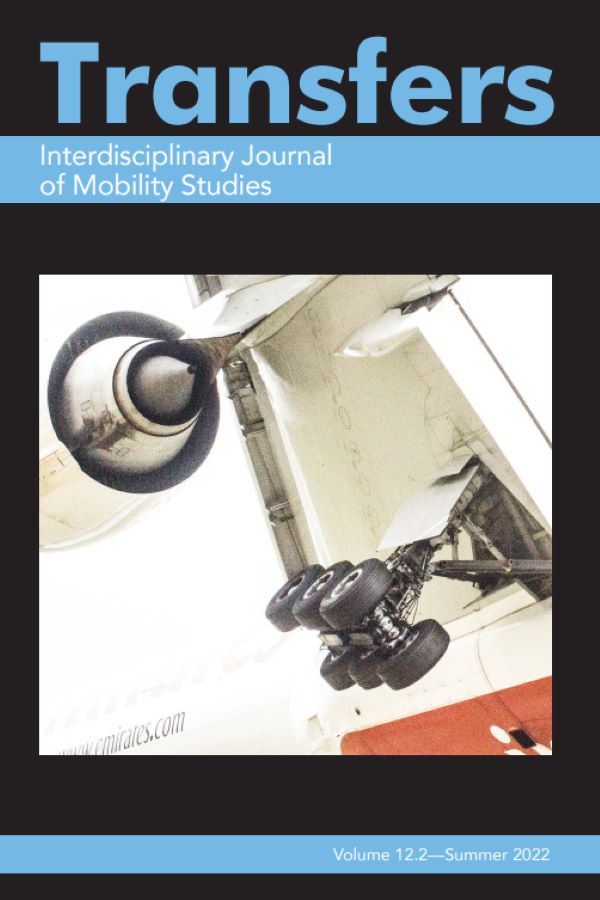
Toward Compatibility in Aeromobility
Past accidents with the Boeing 737 MAX have brought to light the dynamics behind the development of aviation technology and how these impact different stakeholders in the aviation industry, which is known for its siloing practices. Using the investigation of the tragic accident of Lion Air 610 as an exploratory case, we reveal how different forces in the aerospace industry are shaping the ongoing narrative of the Boeing 737 MAX. One way of examining this narrative is through the perspective of distributed situation awareness (DSA). We then argue that focusing on ethnographic storytelling to investigate DSA can highlight
Platform Infrastructures
Mobilizing Passengers, Immobilizing Civic Imaginations?
Katie J. Wells, Kafui Attoh, and Declan Cullen,
Paris Marx,