 Get New Issue Alerts
Browse Archive
- Vol 16 Issue 1
- Vol 15 Issue 3
- Vol 15 Issue 2
- Vol 15 Issue 1
- Vol 14 Issue 3
- Vol 14 Issue 2
- Vol 14 Issue 1
- Vol 13 Issue 3
- Vol 13 Issue 1-2
- Vol 12 Issue 3
- Vol 12 Issue 2
- Vol 12 Issue 1
- Vol 11 Issue 3
- Vol 11 Issue 2
- Vol 11 Issue 1
- Vol 10 Issue 2-3
- Vol 10 Issue 1
- Vol 9 Issue 3
- Vol 9 Issue 2
- Vol 9 Issue 1
- Vol 8 Issue 3
- Vol 8 Issue 2
- Vol 8 Issue 1
- Vol 7 Issue 3
- Vol 7 Issue 2
- Vol 7 Issue 1
- Vol 6 Issue 3
- Vol 6 Issue 2
- Vol 6 Issue 1
- Vol 5 Issue 3
- Vol 5 Issue 2
- Vol 5 Issue 1
- Vol 4 Issue 3
- Vol 4 Issue 2
- Vol 4 Issue 1
- Vol 3 Issue 3
- Vol 3 Issue 2
- Vol 3 Issue 1
- Vol 2 Issue 3
- Vol 2 Issue 2
- Vol 2 Issue 1
- Vol 1 Issue 3
- Vol 1 Issue 2
- Vol 1 Issue 1
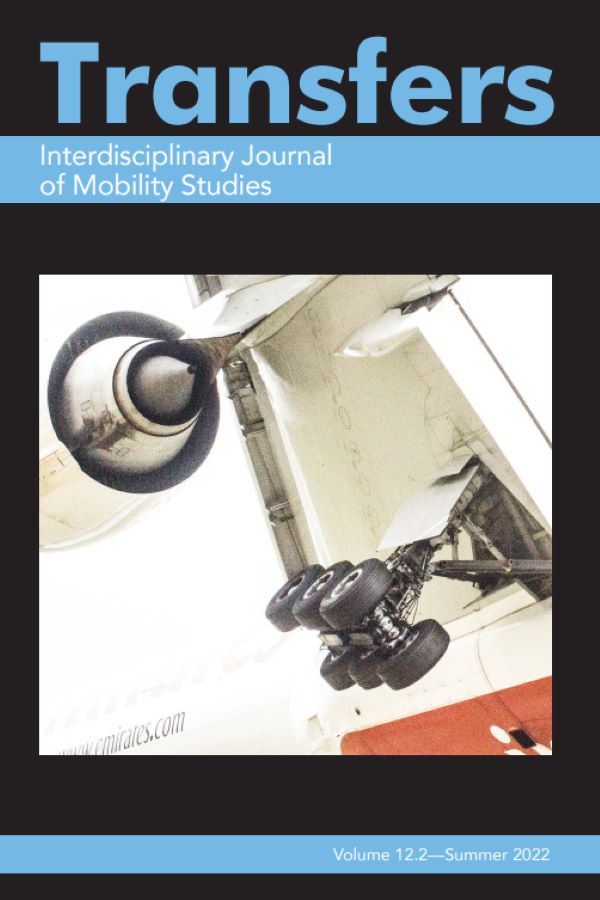
Transfers
Interdisciplinary Journal of Mobility Studies
ISSN: 2045-4813 (print) • ISSN: 2045-4821 (online) • 3 issues per year
Volume 11 Issue 2
Editorial
This issue of
Introduction
Interrogating Aspirations through Migratory Mobilities
While questions focused around social, economic, and physical movement have long been central to human lives, state policies, and economic regimes, the ‘mobility turn’ in academic scholarship has often seen a straightforward association of mobility as an upward trajectory mitigating socioeconomic inequality, as well as equating physical movement emerging from migration with mobility. Here, however, we argue that the relationship between migration and mobility is hardly so automatic, and needs to be considered in its complexities and contradictions. Rather than uncritically celebrating mobility, we consider it as a lens through which disruptions, inequalities, differential access, and the role of identities can be understood.
Desperate Aspirations among Paraguayan Youths
The Renegotiation of Migration and Rural Futures
This article explores how young Paraguayan migrants, returnees, and not-yet-migrants negotiate contradicting aspirations and
Aspiration and Desperation Traps in Trajectories of Physical and Social Mobility-Immobility
Young Female Migrants in the City
Over the last two decades, Bangladesh has experienced a dramatic shift in terms of female rural–urban migration, often referred to as the feminization of migration. Drawing on extensive ethnographic research on young female migrants’ livelihood experiences in Dhaka and Gazipur, this article makes three contributions to the migration and mobilities literature. First, while migration often constitutes an adequate tool for resolving desperation, it may also cause an
“Who Leaves Home If There is a Choice?”
Migration Decisions of Women Workers on Tea Plantations in India
The Dooars tea plantations in India were colonial enterprises set up through recruiting a migrant workforce from Central India. Against the background of the crisis in the Indian tea industry in the early 2000s, and the resulting migration of workers to the cities to join various casual workforces, this article questions the dualities in the framework of migration/displacement and aspiration/ desperation. Through mapping the migration decisions of women workers from the plantations, the article traces the ways in which aspiration often follows from migration rather than predating it. Inheriting a history of displacement as migrant labor brought from Central India, the aspiration expressed is often that of belonging. The article then interrogates how the narratives of displacements feature in narratives of aspiration. The migration strategies are not uniform among all the women, but vary across their life stages and accordingly the possibilities and limitations post-migration differ.
The Post-Deportation Desperation and Refunneling of Aspirations of the Mexicans Deported from the United States
This article uses Carling's aspiration/ability model and the social anchoring concept proposed by Grzymala-Kazlowska to explain the post-deportation experience of Mexicans deported from the United States of America. I analyze how deported people's aspirations are shaped by US migration policies and by their families, as well as by local community obligations. The data comes from seven years of longitudinal research in a rural community in Oaxaca. I conclude that under the immobility regime produced by the US for the deported Mexicans, their aspirations of remigration evolve into desperation. Often unable to remigrate to the US, they are stuck in a limbo of desperation until they refunnel their aspirations and anchor them in Mexico. At the same time, they resynchronize their life courses with other community members.
Healthy Mobilities
In this article, we articulate a distinct conceptual direction at the intersection of health and mobilities scholarship that centers on healthy mobilities. We take inspiration from relational, multiscalar, and more-than-human approaches to foreground an approach that asks what being in everyday healthy motion may entail and whose health is considered. We trace this approach through two brief provocations: exercise and differential mobilities, including the finely tuned movement-repertoires developed by disabled people. These illustrate the value of healthy mobilities, beyond humancentric, cure-oriented approaches to health, to understandings of how health takes shape among diverse living entities in motion. This focus can help foreground the interdependence of human, nonhuman, and planetary health in mobilities.
Novel Reviews
David Mitchell,
Musa Okwonga,
Eco-Aesthetics and Climate Change
Poetic Reflections
Environmental sustainability and ecological aesthetics experience a turbulent affair when academic language is replaced by an artistic register: can we articulate contemporary crises stemming from uncontrolled mobilities, such as hyper-consumption, hyper-automobilities, and technological pollution, better by replacing sociological analysis with affective poetic language? The following poem (unpublished but belonging to the theme of
Book Reviews
Julius S. Scott,
Carl Middleton, Rebecca Elmhirst, and Supang Chantavanich, eds.,
Cajetan Iheka and Jack Taylor, eds.,
Jie Zhang,
Markku Hokkanen,
Natasha Pairaudeau,