 Get New Issue Alerts
Browse Archive
- Vol 16 Issue 1
- Vol 15 Issue 3
- Vol 15 Issue 2
- Vol 15 Issue 1
- Vol 14 Issue 3
- Vol 14 Issue 2
- Vol 14 Issue 1
- Vol 13 Issue 3
- Vol 13 Issue 1-2
- Vol 12 Issue 3
- Vol 12 Issue 2
- Vol 12 Issue 1
- Vol 11 Issue 3
- Vol 11 Issue 2
- Vol 11 Issue 1
- Vol 10 Issue 2-3
- Vol 10 Issue 1
- Vol 9 Issue 3
- Vol 9 Issue 2
- Vol 9 Issue 1
- Vol 8 Issue 3
- Vol 8 Issue 2
- Vol 8 Issue 1
- Vol 7 Issue 3
- Vol 7 Issue 2
- Vol 7 Issue 1
- Vol 6 Issue 3
- Vol 6 Issue 2
- Vol 6 Issue 1
- Vol 5 Issue 3
- Vol 5 Issue 2
- Vol 5 Issue 1
- Vol 4 Issue 3
- Vol 4 Issue 2
- Vol 4 Issue 1
- Vol 3 Issue 3
- Vol 3 Issue 2
- Vol 3 Issue 1
- Vol 2 Issue 3
- Vol 2 Issue 2
- Vol 2 Issue 1
- Vol 1 Issue 3
- Vol 1 Issue 2
- Vol 1 Issue 1
Transfers
Interdisciplinary Journal of Mobility Studies
ISSN: 2045-4813 (print) • ISSN: 2045-4821 (online) • 3 issues per year
Volume 10 Issue 1
Editorial
This current issue marks the tenth anniversary of our journal. The jubilee also coincides and clashes with a critical time for all of us as the world grapples with the COVID-19 pandemic and its consequences. Ten years ago, when Gijs Mom's team launched
Trending
A Decade of New Mobility Studies through the Lens of Transmodality, Transnationalism, and Transdisciplinarity
Looking back on nine years of
Ten Years of
Mobility Studies and Social Change during a Pandemic
In a brief reflection on the multiple disruptions of mobilities imposed by the COVID-19 pandemic, this article shows the significance of the scholarship published in
On Growing a Journal
A View from the South
In this era of the neo-liberal academy, establishing an academic journal is a labor of love and hope. In this article, I celebrate the dedication and commitment of its many contributors and reflect on the value of the arts and humanities to the mobilities paradigm. I do that from the perspective of a feminist historian from a settler colonial polity in the southern hemisphere, where uneven mobilities and the violence of dispossession continue to shape national life. I consider how a mobilities framework that derived from the northern hemisphere has spoken to the intellectual and political projects that played out in a colonial settler nation in the southern hemisphere.
Micro-Mobilities in Lockdown
In this paper I reflect upon my own micro-mobilities and embodied mobile practices living and working under COVID-19 government restrictions in Wales in mid-2020. I use the opportunity to reflect upon the past ten years of
Discipline and Publish?
as Interdisciplinary Site
Ten years ago a new journal that would anchor and foster what would become known as the “new mobility studies” appeared:
at a Crossroads
An Anthropological Perspective
In this short article, I offer a personal reflection on my own mobilities and how these influenced my academic interest in human movement and brought me in contact with mobility studies and
“Text-as-Means” versus “Text-as-End-in-Itself”
Some Reasons Why Literary Scholars Have Been Slow to Hop on the Mobilities Bus
This article explores three reasons why literary scholars have been slow to engage with both the New Mobilities Paradigm and the New Mobilities Studies promoted by
Mobilizing Disability Studies
A Critical Perspective
Despite how the fields of mobility and disability studies have vastly contributed to our understanding of our lifeworld, the two, however, share asymmetric acknowledgement of each other. Mobility recurs as an aspiration for those with a disability yet disability tends to be ignored or inadequately dealt with in mobility studies. This article seeks to achieve two main objectives: first, to discuss how and what the journal has achieved over the years; and, second, to highlight that the denial of mobility is a negation of what it means to be human. Overall, the article seeks to deploy a critical intervention required for mobility studies to return the gesture to disability studies in equal magnitude. By situating the discussion within the context of the ongoing COVID-19 pandemic in Australia, this article argues that at the interface of mobility and disability lies a politics of possibility for people with disabilities in their struggles for equal access and full citizenship.
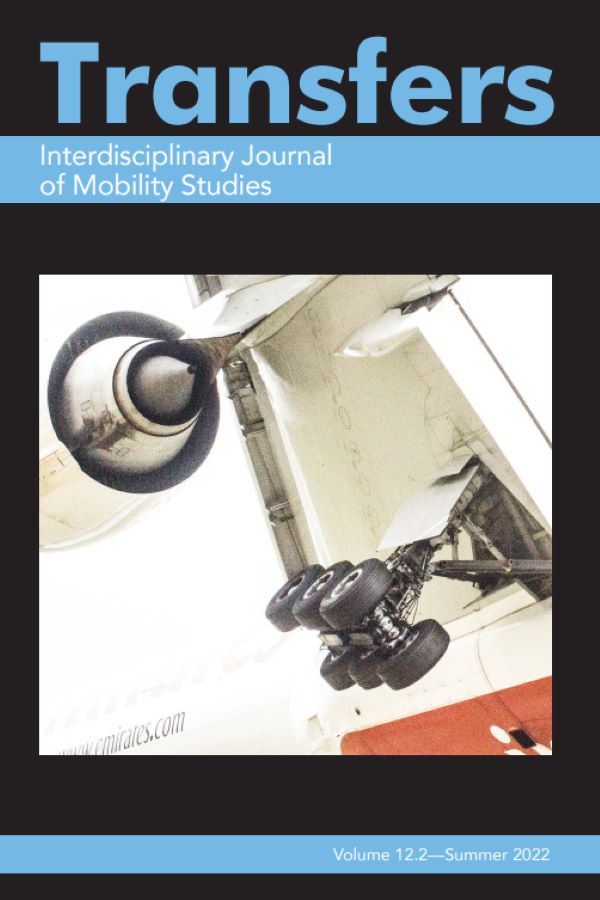
Aeromobilities in the Time of the COVID-19 Pandemic
This Perspective piece marks the ten-year anniversary of