 Get New Issue Alerts
Browse Archive
- Vol 16 Issue 1
- Vol 15 Issue 3
- Vol 15 Issue 2
- Vol 15 Issue 1
- Vol 14 Issue 3
- Vol 14 Issue 2
- Vol 14 Issue 1
- Vol 13 Issue 3
- Vol 13 Issue 1-2
- Vol 12 Issue 3
- Vol 12 Issue 2
- Vol 12 Issue 1
- Vol 11 Issue 3
- Vol 11 Issue 2
- Vol 11 Issue 1
- Vol 10 Issue 2-3
- Vol 10 Issue 1
- Vol 9 Issue 3
- Vol 9 Issue 2
- Vol 9 Issue 1
- Vol 8 Issue 3
- Vol 8 Issue 2
- Vol 8 Issue 1
- Vol 7 Issue 3
- Vol 7 Issue 2
- Vol 7 Issue 1
- Vol 6 Issue 3
- Vol 6 Issue 2
- Vol 6 Issue 1
- Vol 5 Issue 3
- Vol 5 Issue 2
- Vol 5 Issue 1
- Vol 4 Issue 3
- Vol 4 Issue 2
- Vol 4 Issue 1
- Vol 3 Issue 3
- Vol 3 Issue 2
- Vol 3 Issue 1
- Vol 2 Issue 3
- Vol 2 Issue 2
- Vol 2 Issue 1
- Vol 1 Issue 3
- Vol 1 Issue 2
- Vol 1 Issue 1
Transfers
Interdisciplinary Journal of Mobility Studies
ISSN: 2045-4813 (print) • ISSN: 2045-4821 (online) • 3 issues per year
Volume 12 Issue 2
Editorial
There is a humorous old anecdote, told perhaps to greatest effect by the American novelist David Foster Wallace (1962–2006) to open his speech to the graduating class of Kenyon College in 2003:
There are these two young fish swimming along, and they happen to meet an older fish swimming the other way, who nods at them and says, “Morning, boys, how's the water?” And the two young fish swim on for a bit, and then eventually one of them looks over at the other and then goes, “What the hell is water?”
Introduction
Unruly Landscapes: Mobility, Transience, and Transformation
In June 2020, the Centre for Mobilities Research (CeMoRe) at the University of Lancaster (UK) and the Centre for Advanced Studies in Mobility & Humanities (MoHu) at the University of Padua (Italy) co-hosted an international conference on the theme of “Unruly Landscapes.” As a result of the pandemic, the two-day event had to be moved online, but participants nevertheless enjoyed two days of inspiring discussion as the speakers engaged with the intersection of landscape and mobility from a variety of disciplines and approaches.
Migrating Landscapes
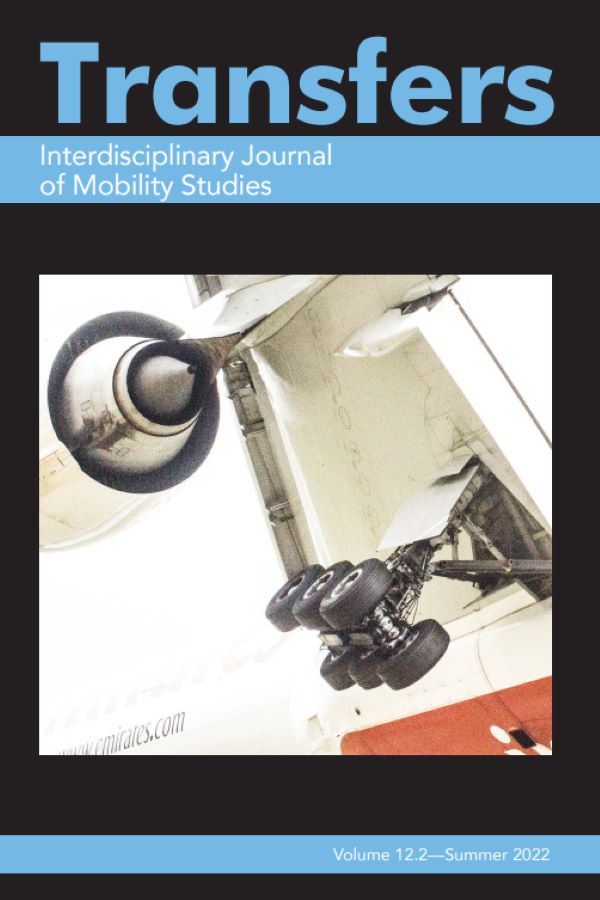
This article, one element in a multifaceted art research project, explores the agency of the aircraft landing gear compartment (wheel bay) in global transfer. It takes as its beginning histories of human and other-than-human actors falling from aircraft wheel bays as aircraft descend into London Heathrow and asks what art research can bring to the problem of their political and ethical framing. Its theoretical touchstones include John Ruskin on dust and the object-oriented philosophies of new materialism. These are brought into conversation with an account of the process of modeling and exhibiting a wheel bay, as well as extracts from a microstratigraphic survey conducted on the original. The article ultimately contends that the wheel bay gives shape to otherwise intangible aeromobilities, knowledge of which is integral to a nuanced understanding of the political geography of airspace at London Heathrow.
Visual and Toponymical Landscape
Place Names on Railway Station Signs
The toponymical landscape is created by and perceived through place names. A place name arises when a society attributes values to space but, with the transformations of societies, it can evolve or simply be accompanied by new specifications. This study analyses public transport station names. It indicates how urban facilities need to be specified on the signs, and also reveals the way in which companies purchase the right to rename locations for advertising purposes. A spontaneous process of place name attribution is designated “unruly,” while the word “ruly” signals a sponsored event, with evident privatization of the public space.
A Parallax Reality
Shaping the Present in Paul Auster's and
Engaging with the US author Paul Auster's fiction, the article explores how the stories his characters tell, in order to survive traumatic experiences, move them across their urban landscapes. Focusing on Auster's
Absence, Presence, and Mobility
A Landscape Approach to an Unfinished Tram Project
This article works at the intersection of mobilities and landscape studies. It shows absence-presence as a principal means by which mobilities are related to landscape, thus enabling the concept of landscape to be elaborated with regard to the politics of community, the ways in which embodied practices manifest themselves and create place, and the intertwinement of the cultural and the natural. To elaborate the conceptual argument, the article presents the case study of a planned but never fully realized high-speed tramline running through a residential area of Tallinn, Estonia. To explore the multiple absences of what was planned and the presence of imagined and a few realized landscape elements, the article makes use of artistic works, such as a skiing performance of infrastructure re-creation (
English Wetland Immersions
Encountering, Slowing, Navigating, Imagining in Terrestrial Water Worlds
Hark—the Tiddy Mun, lurching from the murk. Beware Will-o’-the-Wisp, seducing benighted travelers into the swamp. Hear the padding of the Black Shuck. The incumbents of moors, marshes, fens, and levels mobilized their
Dreams and Parables of Sustainable Mobilities
There is a myriad of ideas, often from companies and governments, on what sustainable mobilities should look like and how people should be engaging them. Yet top-down narratives do not always adequately reflect laypeople's mobilities on the ground, and so this article explores the idea of dreams as a way of subverting pre-existing imaginations and redistributing freedoms to move sustainably on one's own terms. Dreams as imaginative forms of inquiry could also expand epistemic frontiers to include voices that have hitherto been under-represented. Where personal dreams contest the status quo, the aim is not about dismissing the productive possibilities from experimental dreams of the technological elite. Instead, this discussion uses the rhetoric of parables as a way to caution against enterprises that expand too quickly without means of care to sustain operations. Thus, this article suggests the labors of repair and maintenance as future avenues of research for sustainable mobility.
Book Reviews
Silvia Vignato and Matteo Carlo Alcano, eds,
John Wei,
Ben Nobbs-Thiessen,
Gretchen Sorin,
Candacy Taylor,