 Get New Issue Alerts
Browse Archive
 PDF issue available for purchase
 Print issue available for purchase
- Vol 11 Issue 1
- Vol 10 Issue 2
- Vol 10 Issue 1
- Vol 9 Issue 2
- Vol 9 Issue 1
- Vol 8 Issue 2
- Vol 8 Issue 1
- Vol 7 Issue 2
- Vol 7 Issue 1
- Vol 6 Issue 2
- Vol 6 Issue 1
- Vol 5 Issue 2
- Vol 5 Issue 1
- Vol 4 Issue 2
- Vol 4 Issue 1
- Vol 3 Issue 2
- Vol 3 Issue 1
- Vol 2 Issue 2
- Vol 2 Issue 1
- Vol 1 Issue 2
- Vol 1 Issue 1
Screen Bodies
The Journal of Embodiment, Media Arts, and Technology
ISSN: 2374-7552 (print) • ISSN: 2374-7560 (online) • 2 issues per year
Volume 6 Issue 1
Editor's Introduction
The Affective Modalities of Media and Technology
The six essays in this in this issue of
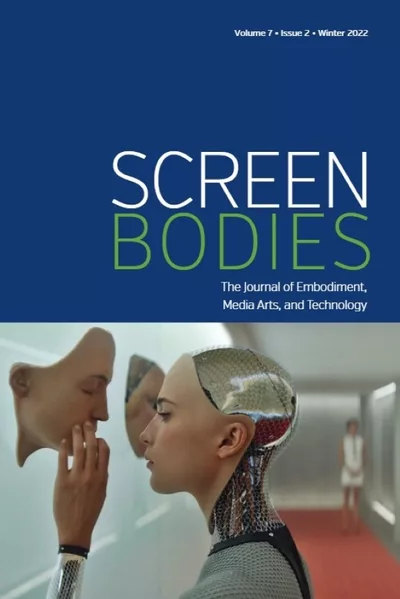
About the Cover
The cover of this issue of
Alexa, Affect, and the Algorithmic Imaginary
Addressing Privacy and Security Concerns Through Emotional Advertising
As millions of customers across the world invite digital voice assistants into their homes, the public debate has increasingly centered on security and privacy concerns connected to the use of the device. Drawing on Tania Bucher's work at the intersection between technology and everyday experience, this article proposes an understanding of an algorithmic imaginary of Alexa-enabled devices as explicitly nonthreatening in its ordinariness, positive potential, and gendered presence. As a case study, this article uses commercials for Alexa-enabled devices as a starting point: Instead of foregrounding the functionality and thereby the algorithmic intelligence underlying the voice assistant, these commercials focus on an affective potential as a narrative strategy to address privacy and security concerns. By connecting everyday interactions with emotional and empowering narratives, the way Alexa is portrayed as an embodied object functions as a balance to the equally public and publicized understanding of digital voice assistants as threats.
Modernist Embodiment
Sisyphean Landscape Allegory in Cinema
This article embarks from George Lakoff and Mark Johnson's embodied understanding of metaphor in linguistic contexts and proceeds beyond merely an extended notion of “visual” metaphor toward an operational understanding of the term “allegory” in the cinematic context. Specifically, a pattern of Sisyphean landscape allegory in a global array of postwar narrative cinema is identified and explored, in which a psychologically conflicted protagonist struggles against a resistant natural landscape, connoting varying degrees of existential “futility.” The recurrent experiential configuration of this modernist allegory on screen, especially in terms of its haptic dimensions, is explored for its ability to “invoke” social critique—as felt, visceral content.
The Film Series
Activating Empathy Through Virtual Reality
This article explores the innovative use of virtual reality (VR) technology in nonfiction documentary film formats by animal-advocacy organizations. I examine the potential of the VR medium to communicate the living and dying environments of factory-farmed animals, and to generate viewer empathy with the animal subjects in their short, commodified lives from birth to slaughterhouse. I present a case study of the
A Body of Texts
and
This article applies materialist rhetoric to Christopher Nolan's 2000 neo-noir film
Affective Anachronisms, Fateful Becomings
Movement and the Joan of Arc Effect in Type-Moon's Transhistorical Anime Ecology
This article examines the temporal and phenomenological philosophies of Gilles Deleuze, Félix Guattari, and Paolo Virno, specifically in relation to the transmedia franchises of the Japanese game studio, Type-Moon. Against linear, national, and majoritarian grand narratives of the historical, the
Prosthetic Vision and Postmortem Cinema
The nineteenth-century science of “optography” was based on the idea that an image of the last thing seen at the moment of death would be imprinted on the retina. This idea was inspired by the invention of photography, which reinforced the mechanistic notion of the eye as a camera, and it was frequently criticized in nineteenth-century literary texts, in which eyes more often record images generated from within the mind. Belief in optography began to wane at roughly the same time that cinema became a popular form of entertainment, but it continued to appear in several films in which severed eyes function as cameras or optical implants are used to record visual impressions that can be viewed after the death of the subject. This article examines how these optographic narratives continued to reinforce the mechanistic notion of visual perception on which film technology was thought to depend.
Review
Erin Y. Huang.