 Get New Issue Alerts
Browse Archive
 PDF issue available for purchase
 Print issue available for purchase
- Vol 10 Issue 2
- Vol 10 Issue 1
- Vol 9 Issue 2
- Vol 9 Issue 1
- Vol 8 Issue 2
- Vol 8 Issue 1
- Vol 7 Issue 2
- Vol 7 Issue 1
- Vol 6 Issue 2
- Vol 6 Issue 1
- Vol 5 Issue 2
- Vol 5 Issue 1
- Vol 4 Issue 2
- Vol 4 Issue 1
- Vol 3 Issue 2
- Vol 3 Issue 1
- Vol 2 Issue 2
- Vol 2 Issue 1
- Vol 1 Issue 2
- Vol 1 Issue 1
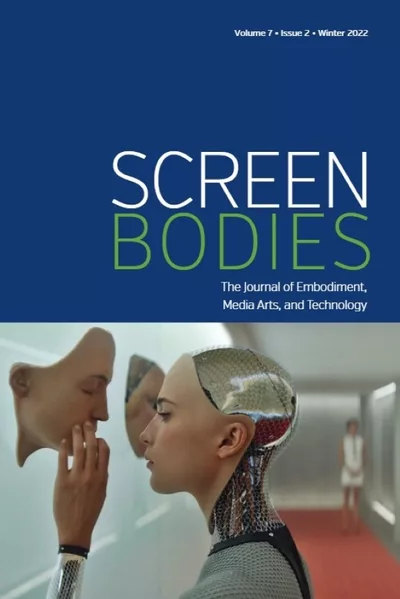
Screen Bodies
The Journal of Embodiment, Media Arts, and Technology
ISSN: 2374-7552 (print) • ISSN: 2374-7560 (online) • 2 issues per year
Volume 10 Issue 2
Screening the Monstrous-Feminine
Abjection, Revolt, and the Feminist New Wave
This issue of
All I Wanna Do Is Make a Meal of You
Feminist New Wave and the Rise of the Cannibal Woman
The Feminist New Wave refers to a movement defined by Creed as films directed primarily by women that explore central female characters in revolt against patriarchal values challenging what it means to be a woman under these conditions. Three films are explored in this article;
When “It” Stops
Beauty, Monstrosity, and Violence in Coralie Fargeat's
In Coralie Fargeat's 2024 film, the titular “substance” is a seductive product that promises Elisabeth Sparkle, a fitness instructor and television icon played by Demi Moore, a “younger, better, more perfect” you. Fargeat's film is the first of its kind to use body horror as a powerful condemnation of the ever-accelerating commodification of women's appearance under late capitalism, and the violence inflicted on its constituents. This article explores a history of feminine expression of violence inscribed on the self through art and film, especially in the New French Extremity. Turning to a discussion of the abject and the monstrous-feminine using the work of Julia Kristeva and Barbara Creed, this intervention shows how Fargeat's deployment of body horror graphically brings into sharp focus the violence of the ideal female commodified body, ending in an explosive confrontational indictment of what Laura Mulvey calls “to-be-looked-at-ness.” This article seeks to complicate and elaborate on the accelerated commodification of the female body as demonstrated by Fargeat's mobilization of the body horror genre.
Bitches in Beartraps
Women in and the Commodification of Mutilating the Female Body
As one of the most notorious franchises in horror history,
, Exploded
Lessons of Formlessness and the Black Hole
Claire Denis's 2019 film
The Ethics and Aesthetics of the Atomic Bomb Films
Comparatively analyzing the representation of bodies in atomic bomb films,
Narrating Loneliness
The Robotic Moment in “Be Right Back” and
In
Joyful Transgressions
Genre Mixing, Musical Disruptions, and Melodramatic Spectacle in
Melodrama can be a productive genre for excavating and troubling social categories beholden to white heteropatriarchy, but the genre's disruptive power is not typically extended to trans films. Rather than utilizing melodrama's archetypal emotional spectacle to draw attention to genders’ incoherence, mainstream cinema relies on melodramatic tropes and sentimental pedagogy to engender pity for the preternaturally melancholic trans figure. Anxiety about the trans body, whether personal or cultural, therefore becomes the definitive mode for representing trans experiences on-screen. Given the genre's transnormative history, in particular its ambiguous treatment of trans femininity, how might filmmakers reclaim melodrama's critical social voice in service of a more radical trans agenda? And how might interventions by other spectacle-driven genres, like the musical, facilitate a more productive engagement with trans culture?
And the Last Shall Be First
Playing Wretched in
In survival horror games, the player is supposed to win by surviving but in Red Barrel's 2013 game
Screening the Subject
A Review of Multimedia and Video Artworks in the Exhibition
Theory of the Digital Body
Narrative, Performance, and the Self
This is the tenth year of
“I Feed You My Limbs”
Haunting and Hunger in Sally Wen Mao's “Live Feed”
On social media sites, both digital bodies and user to user experiences continuously destabilize the binaries life/death (or living/dead). The slippage of life/death digital social media members experience is made particularly salient in Sally Wen Mao's poem “Live Feed.” In the poem, the unnamed speaker is a personified piece of uploaded information—a nonliving actant—circulating in a social network's live feed, the place where information is devoured. I define this experience as “zombie hunger” as it applies to digital social network use and develop better language to trace self-representation on Facebook and Instagram and the material, embodied, and laboring human/nonhuman forces that allow for this body of knowledge to be accessible.
Dreaming in Blue
The Autopoetry of Inès Bouallou
This article examines some of the self-portraits that Inès Bouallou, a young, Moroccan autodidact, has posted to Instagram. Bouallou sometimes calls her posts “autopoetry,” arguably one of autotheory's related genres. Through the lens of autotheory, which couples autobiography with theory, this article analyzes three features of Bouallou's autopoetic practice. She often cites literature alongside her self-portraits, thereby creating a dialogue between others’ words and her own life. In addition, Bouallou's self-portraits stage performances that put the self's coherence and stability into question. Finally, her photographs depict provocative instances of self-care, moments when the artist takes care of another incarnation of herself. Ultimately, this article aspires to inform autotheorists and others in the Global North of a comparable practice in North Africa.
Border Screen(ings), Or How to Undocument a Body
The spectacle of war in the US-Mexico border is ubiquitously projected onto the screens that mediate our daily life, so that the screen (and the process of screening) becomes part of the discourses and material conditions of colonial capitalism, structuring our relationships with our and Other bodies. Xandra Ibarra's video performance in
Experiment No. 27
Experiment No. 27 and others are each multiscreen choreographic components of the installation
Moving Beyond the Spear
Kelly Reichardt and Ursula K. Le Guin in Dialogue
This article explores Kelly Reichardt's
The Impact of COVID-19 on HBO's Season 4
The Rejection of the Posthuman Body
Although
Playing with Memory
Neurogames as a Means of Preserving Selfhood in Alzheimer's Disease
Alzheimer's Disease (AD) is a condition that results in the slow deterioration of a person's memories and eventually their cognitive function. As this condition is so feared, there are several stigmas surrounding the disease. This article focuses on how neurogames, games that focus on neurological conditions where players play as either the patient themselves or alongside them and are developed for educational and entertainment purposes, may help address these stigmas and provide new means for expressing selfhood and consciousness.
Substances in Play
The Game Body and
This article examines Timothy Crick's notion of the game body, thinking beyond the visuality that defines cinematic “film body,” an embodied subject–object that mediates the sensation of a film to the viewer. Examining
Kara Walker's Uncanny Valley in
This exhibition review of Kara Walker's
Book Review
Violet Lucca,
Screening Authority
Agency, History, and Power
Welcome, readers, to the final installment of the ninth volume of
A New Cyborg Feminist Paradigm as Multilithic Print
Navigating Trauma and Algorithmized Self-Making in “Breonna's Garden”
This article reimagines discourses around race and gender within collaborative cultural productions by investigating how trauma is computed via visual images and human-computer interactions. I argue the use of digital collaborative formations—particularly that of oppositional writing in socially mediated spaces—provokes modes of encounter that enact a shared distributed experience of different ways of printing new paths in and out of trauma. By analyzing the digital storytelling taking place in “Breonna's Garden,” an augmented reality application that tells the story of Breonna Taylor, I clarify how digital technologies serve as an avenue for transformative recoding of the mechanisms of racialization.
Twitter's (and X's) Star and Heart Buttons
Emotional Frictions and Tweeted Gender and Sexuality Norms
Twitter's 2015 change from the star to the heart button caused many participants to antagonistically respond. This modification was supposed to enable participants’ easy and frictionless engagements. Nevertheless, it caused friction, including journalists’ identification as dismissed super users who were contaminated by the heart's feminine references. I employ close reading to study news stories, posts, and Twitter's narratives about the buttons. I cite academic scholarship on friction, feelings, buttons, and gender scripts as a means of arguing that Twitter's heart button was sometimes understood as frictionless, but it was also refused because of negative connotations. While such scholars as Sebastián Lehuedé and José Medina argue that individuals can employ friction to intervene in intolerance, my humanities study underscores how gender and sexuality norms are reproduced.
“TikTok made me realize I had ADHD”
Social Media's Techno-Cultural Authority on Health and the Body
This article interrogates how TikTok has become a voice of authority in the self-diagnosis of ADHD and builds on theories of social, cultural, and algorithmic authority, to offer a theoretical framework of “techno-cultural authority”. Through a digital ethnography and analysis of ADHD TikToks and the technological infrastructures and assemblages surrounding the TikTok app, I demonstrate how ADHD TikTok content creators adopt visual and discursive norms from other trending TikTok content and traditional visual media content to generate authority, and to ensure their videos are deemed viewable and relevant by viewers and the algorithm. Contrary to traditional understandings of medical authority, I find that authority on TikTok is not produced by individuals or institutions, but rather by content creators who engage, en masse, with the supporting technologies of the TikTok app to reproduce familiar trends and visual norms.
in Thick Time
Imaging the Alternative Time and Agency of Chinese Women
This article explores women's re-appropriation of the national discourse of history and heritage in contemporary China. Examining women artists’ recreation of Silk Road heritage objects, I demonstrate how they produce a new narrative of women's time that, in turn, generates an alternative form of agency. In remaking the figure of the
Eat Me, Bones and All
Cannibalistic Depictions of Queer Love and Desire in Horror Films
In the early 2020s, queer cannibalism rose in significant popularity with films such as Luca Guadagnino's
Vehicles of Vision
Dystopian Drivers and the Chase, from to
Anxieties generated from the challenges of sustainable and equitable societies and the hopes for transcending routes through uncertain times have often found their paths crossing within the motion sequence of the dystopian car chase on film. Each decade has met this crossing—of frightening futures and fleeting freedoms—with its own set of driving rules and transport-based dimensions. From
, the Pandemic, and the Staging of the Crisis of Capitalism
Grifters, Animal Lovers, and the Ending of Capitalist Triumphalism
This article examines the series
Cyborg Skin
Posthuman Feminism and the New Body Criticism
We are pleased to present an excellent collection of articles that represent the newest directions in what Barbara Stafford called “body criticism.” The authors in this issue of Screen Bodies work in diverse fields and employ a wide range of methods, but all share a concern with spectatorship and the ways that the effects of screen-based technology are mediated by the body. This research centers women and offers advancements in feminist film theory, posthumanism, and studies of the horror genre.
Enhancing Empathy Through the Body
Exploring the Intersection of Cinema and Performance
In recent years, many scholars of performing arts, cinema, and mass media have been focusing their studies on the body, examining the perception of the physical experience of projection and connecting bodily states with spiritual and ethical constructs. The purpose of this article is to present how cinema and performance can utilize the body in ways that enhance the audience's empathy. The role of cinema is to enable the viewer to liberate their body from its “individual ownership” and to rediscover its potential. Similarly, performances challenge the audience to respond with their bodies to the stimulation of certain emotions, experiencing a pure sensation through participation. However, experiencing empathy, a viewer can impose their ideas or reactions onto the experiences or emotions of others, believing that what they are experiencing is what others experienced.
Transcending Transcendence in Jim Jarmusch's
Building on Paul Schrader's thesis in
The Inter-Subjective Touch in
This article examines the inter-subjective touch in Ildikó Enyedi's film
Powers of (Body) Horror
and the Queer Posthuman Abject
French film director and screenwriter Julia Ducournau's sophomore body horror film,
Beyond Humanity
Unveiling Posthumanist Themes in Charles Stross’ and its Literary Nexus
Posthumanism stands as a complex and interdisciplinary intellectual movement that challenges and broadens conventional notions of human identity and existence, particularly in light of advancements in science and technology. It emerged in response to the swift evolution of technology and its profound impact on our understanding of what it means to be human. Embarking on a posthumanist inquiry, this research delves into the rich fabric of Charles Stross’
A Transpacific Study of Anorexia Awareness and Popular Culture
This article looks at how the “anorexic condition” gained public awareness through popular culture, specifically in the United States and Hong Kong, and argues that the 1980s saw the beginning of anorexia awareness-raising in the American public, contributed by the untimely death of Karen Carpenter and the rapid expansion of consumerism. It uses racial, feminist, and disability theories to interrogate how their intersections defined and continued to shape anorexia. It examines the paradox that popular culture could be the very same agency that creates both such oppression and the “redemption” of its problematic consequences. This leads to a critical evaluation of the nature of popular culture, its influence on young people and their body image, and its prevailing influence on global society.
From Invisible to Visible
The Gentle Power of East Asian Female Directors in Shaping Women
Asian women are often marginalized in global contexts, and they are often disembodied or presented in sexualized images in film and television productions. Even in the Asian region, Asian women have difficulty giving themselves a voice in popular culture. This essay has selected three films and tends to explore the gender connotation, body, and sexuality in the film works of East Asian female directors in recent decades, with the intent to explore the female sexual desire that is expressed and reflected in those female directors’ works.
The Triple Cut
How to Tear the Female Body to Pieces on Screen
The main object of study in this research is the cutting of the female body in cinema. In order to simplify and rationalize such a broad and diffuse concept, it is necessary to redesign a methodology of analysis valid for the object of study at hand, which will be called the Triple Cut. This will advance self-referentially, as if it were Russian dolls, from the cut of the real itself, passing through the cut of the plane (or between planes) or the absence of the same, until arriving at the cut of the flesh itself. This is where the bodies end up being dismembered live in front of the camera's lens, pouncing like pieces of meat on the—willing or unwilling—audience.
Touch and Go
The Politics of Hapticity, Affect, and Embodiment
This issue of Screen Bodies features articles that contribute to a group of closely related critical concerns, namely, the existential and political significance of tacticity, feeling, and the representation of embodied experience. In her article, “Feeling Like Death,” Caitlin Wilson examines the aesthetic strategies Agnes Varda employs in two early films, La Pointe Courte (1955) and Le Bonheur (1965), that emphasize “textures and tactility” in the portrayal of mortality, death, and mourning. Wilson shows how Varda uses haptic imagery and calculated cinematic techniques to convey an experience of grief that is “palpable as well as visible.” Wilson persuasively argues that Varda depicts the embodied feeling of mortality to create a heightened sense of intimacy between the films’ characters. Similarly, in her timely article, “Gut Feelings,” Jennifer Jasmine White argues that Sheena Patel challenges the trend towards emotional indifference or “flatness” in the emerging genre of “internet novels.” In contrast to the affectless, numb, and apathetic heroine characteristic of novels like Lauren Oyler's Fake Accounts (2021) and Ottessa Moshfegh's My Year of Rest and Relaxation (2018), Patel's I'm a Fan (2022) features a more realistically emotional protagonist. White argues that the novel functions as an intervention that opposes affective indifference and the political apathy it inspires. She writes that most examples of the so-called internet novel, that is, literature that focuses on social media, influencer culture, and characters who are chronically online, suggest highly mediated social experience leads to emotional and political malaise. Patel rejects this trend and instead centers “the feeling body,” the embodied experience of life online, and the political agency it fosters.
Feeling Like Death
How (1955) and (1965) Construct a Palpable Aesthetics of Mortality
Agnès Varda's early narrative films are texturally rich meditations on love and mortality. Each film uses aesthetic strategies that lend a palpability to the heartbreak, grief, and loss explored therein. This article examines how Varda's use of hapticity makes the morbid enticing, luring the viewer closer to the films’ surface. I particularly examine how these films balance narrative storytelling alongside palpable images, investigating whether films are seen, felt, or both simultaneously.
Gut Feelings
Flatness, Appetites, and Aesthetics in Sheena Patel's
This article reads
Emoji
A Baroque Body in the Theatricality of Online Interactions
Online users devise different strategies and techniques to make up for the absence of physical bodies in online communications, one of which is using emojis. Emojis are a diverse set of small images, symbols, or icons, standardized by the Unicode Consortium for utilization in electronic communication platforms. Their primary role is to effectively convey the emotional attitude of the writer, succinctly provide information, and playfully communicate messages. This article posits that bodily emojis (emojis portraying a body gesture or facial expression) are a form of digital embodiment. Their usage, thus, creates a form of digital performance. Emojis appear as a screen body in a space that lacks the physical one. Furthermore, I suggest that this body could be described as aesthetically Baroque. My proposition is that emojis exhibit Baroque characteristics such as dynamic and exaggerated forms and decorate texts. Emojis share similarities with the appearance and function of the Baroque body both in Baroque visual art and Baroque dance.
Trans* Joy as Resistance
, , and Affective Trans* Embodiment under Capitalism
Theorist Lauren Berlant defines inconvenience as an affect, one exerted by dominant forces onto subordinate populations. In the same way subordinate populations exert inconvenient affects as well, creating a dynamic of dominant and subordinate inconvenience through which social power relationships may be understood. Following this structure, this article charts the dominant and subordinate affects exerted by capitalism and trans* bodies, respectively, and how capitalist oppression responds to and shapes trans* embodiment. Through an autotheoretical lens, this relationship is here examined in the 2020 film
Spectacle of the Demonic Other
Transcoding Evil in
The monster-as-queer trope in horror cinema historically implemented the binary of self-versus-other as heterosexual heroine versus queer monster/villain. With the rise of queer creators and spectators within horror, this trope was questioned so that the queer(ed) monster became multifaceted. From its birth, the horror anthology series
Princesses, Bad Little Boys, and Normal People
Fluidity and the Queer Body in
Biometrics, Dualities, and Fluid Identities
Decentralized Response to the Modern Normalization of Biopower
Categorized by what Michel Foucault called the “biopolitics” of life, the modern human body is reborn into a defamiliarized incarnate social entity that embodies an ecology of different kinds of augmentations. How do the mechanisms of biopolitics create normalized bodies and identities, and what are the real stakes of this new biopolitical power? This article investigates a genealogy toward the contemporary definition of identity and how biopolitics induces and creates a modern milieu of dualities. It then proposes a concept of “fluid identities” as a disruptive, provocative, and whimsical design intervention. It recognizes fluidity to be a presumed agentic human condition and a widely acceptable social factor; it recognizes identities to be “fragmented yet authentic” and “incomplete but sufficient.”
Review
Steffen Hven, Enacting the Worlds of Cinema (Oxford: Oxford University Press, 2022). ISBN: 978-0-19-755510-1. pp. 216. $75.
Affect and Empathy
The Phenomenology of Perception and Spectatorship in Screen Media
Our summer issue begins with a three-part special section on phenomenologies of perception in screen media. These articles focus on novel technological means of representing embodied, lived experience, as well as ways that visual media can impact embodied spectatorship. Each examines media artworks that attempt to represent the seemingly intangible, such as loss, decay, and temporality. The authors in this section offer nuanced and ethically oriented phenomenologies of vision, motion, and time. In “Projecting the Colors of Vision,” Wendy Haslem discusses how artists working in animation, cinema, and virtual reality use visual media to represent the lived experience of sight loss. Haslem analyzes the “haptic optics” of Yoav Brill's
Projecting the Colors of Vision
“Projecting the Colors of Vision” investigates the role of color in the depiction of changing visual dispositions across four screen texts and the technologies that create them. This article explores the role of color in the depiction of color blindness in the abstract cell animation,
Rethinking Bergson's and Deleuze's Theories of Movement
The Material Ontology of Analog and Digital Moving Images, and the Disciplines of Creation in Digital Artworks
Following Henri Bergson's third thesis of movement in
Aesthetics of Slowness, Aesthetics of Boredom
Productivity and Tedium in the Cinema of Tsai Ming-liang
Within the contemporary discourse on slow cinema and independent arthouse filmmaking, emerges the figure of Malaysian-born, Taiwan-based director Tsai Ming-liang. His works, situated at a crossing between different forms of expression—film and installation, narrative film and ethnography—have often been deemed tiresome,
Identification and Contagion in Anna Rose Holmer's
“Identification and Contagion” asks the question of how film can address the body of its viewer in an ethical dimension. Because contemporary movements such as Black Lives Matter and #MeToo have insisted that being in public means always being a raced and sexed body, film's ability to address audiences as though they were perspectives divorced of corporeal matter must be considered an ethical problem. The 2016 film
The War of Desire and Technology in
The media theorist Sandy Stone has referred to flattened and digitized modes of communication in terms of “tokens,” using this framework specifically to address the ways in which we employ technology to compress, send, and receive desire. In taking up this thread, this article examines how tokens of desire are compressed and passed through the specific video game genre of dating simulators. While addressing a number of popular titles, the article highlights one offering in particular, the 2017 release
Becoming Other, Becoming More
Ontological Continuity in Fictional Feminist Transsexual Autobiography
This article examines how continuity is dealt with in fictional feminist texts that depict gender or sexuate transition, via surgical intervention or transmogrification, in terms of naming and pronoun use, self-image, and perceived image. The texts here examined—literary and filmic works by cis artists Angela Carter, Sally Potter, and Octavia Butler, principally—all pastiche the familiar narratological mode of transsexual autobiography, aping the convention of internal focalization, though each elides the wrong-body formula that frequently accompanies such narratives to justify access to medical treatment and care. I situate each alongside scholarly engagements with transsexual embodiment, surgery, and lived experience, with particular focus on flesh as that which both contains and determines gendered and sexed readings, to ground these fictive accounts of becoming.
“So, what you been up to…for twenty years?”
The Aging Body in Time-Critical Sequels
Implicitly or explicitly, society constantly gives us the imperative never to age, to keep our bodies and minds young in order to be valuable—this is particularly the case for women. However, the ageing body tells a valuable story that is worth tracing and analyzing in more depth. In this article, I explore two groups of films in which the ageing bodies of the characters and actors contribute to understanding the narrative of what I call the time-critical sequel. These are sequels produced several years or even decades since their original story was released, in which the years between one film and the other are incorporated into the narrative. First, I will define the time-critical sequel and how it interacts with its parent film. Following, I will develop how the duality of the ageing body of the character/actor, along with their corporeality and embodiment, becomes the means through which a story is told on our screens. I will do this by analyzing Richard Linklater's
New Narratives of Madness in Popular US Television
This article examines a 2010s wave of US primetime television shows centered around the experiences of mad or distressed characters. Drawing upon research in critical disability and mad studies, the article identifies positive trends in US media surrounding mental disability, distress, and medication. Although the portrayals of madness in the shows discussed are complex and not without issue, this article argues that these series make space for alternative narratives of madness in popular culture that do not rely wholly on stereotypes of crime, genius, or violence.
Review
Steinbock, Eliza. Shimmering Images: Trans Cinema, Embodiment, and the Aesthetics of Change. Durham: Duke University Press, 2019. 248 pp. Cloth, $102.95; Paperback, $26.95.
Algorithmic Aesthetics
Bodies and Subjects in the Era of Big Data
Though the authors in this general issue of
Quantities Over Qualities
Metric and Narrative Identities in Dataveillant Art Practice
In a society suffused with surveillance technologies and practices, which persist in their extension across and into all dimensions of human experience, members of the contemporary art community have made significant contributions to the ontology of the surveillant self. This article compares recent works by several prominent multimedia artists who have explored the radical potential of dataveillance as a way to bridge the disconnect between quantitative (metric) and qualitative (narrative) representations of self in the Information Age. By considering the questions raised by three recent art projects—Hasan Elahi's
Narrating (Sur)face
The Marquardt Mask and Interdisciplinary Beauty
As plastic surgery becomes increasingly normalized as an act of self-care, it is essential to consider the ways in which facial beauty has been enacted as data on the surface of the body. Taking seriously the paradox “raw data is an oxymoron,” this article explores how facial beauty has been algorithmized in the recent past as a geometrical proof based on the golden ratio. As an overlay system founded in the late 1990s, the Marquardt Mask claims to beautify any face. Yet, it achieves this universalism via its interdisciplinary exploitation of mathematics and biology. The mask thus participates in a cybernetic paradigm of control by abstracting human faciality as an aesthetic feedback loop evidenced in life and nature.
Cyborgian Salariats
Rationalization and the White-Collar Worker in Sasha Stone's “Hundred-Horsepower Office”
This article examines Sasha's Stone's photographic constructions of the salaried worker, or
Welcome to the Machine
Artificial Intelligence on Screen
Artificial intelligence has been a topic of fascination for film and television since the earliest appearances of robots on our screens, bringing with them questions about ethics, sentience, and the long-term fate of humanity. This article explores depictions of artificial intelligence on screen from a thematic rather than chronological viewpoint. Themes explored include the popular sci-fi trope of robot rebellion, androids as worker/slaves, and intimate relationships between humans and AI. The article also raises philosophical questions of why we wish to create robots in our own image, and what AI sentience, in both android bodies and more elusive disembodied forms, could look like. A range of films and television series—from the
The Face of the Future
An Ethical Examination of Lucrecia Martel's
Lucrecia Martel is an accomplished film director and creative. Her 2019 short film
Loneliness and Love
The Potential of Human-AI Relations as Explored by Contemporary Science Fiction Cinema
Science fiction films about artificial intelligence have often perpetuated anxieties about new technology as a widescale threat to humanity. However, more recently, the genre seems to be moving toward more positive and open-minded representations of technology that envision humans embarking on relationships with AI in varying capacities—perhaps a reflection of technology's increasing value and permeation within all aspects of contemporary wider culture. Thus far, such texts have been given little scholarly attention, yet they offer significant insights into our possible coexistence with advancing technologies of the future. This article analyzes three contemporary science fiction films about artificial intelligence and demonstrates how they are offering unique perspectives that lend support to wider applications of AI, specifically as social companions.
Lu Yang
An Artist in Transformation
Lu Yang (陆扬, 1984) is a critically acclaimed new media artist and rising star based in Shanghai, China, who works across film, games, performance, and installation. His work has been exhibited at numerous biennales and exhibitions in China and around the world, including the 59th Venice Biennale in 2022. He has collaborated on videos with high-profile rock bands like The 1975, and one of his videos featured in a 2020 fashion show of the Chinese sportswear company Li-Ning.1 Lu Yang has also won prestigious awards, including the BMW Art Journey Culture award in 2019, and Deutsche Bank's Artist of the Year award in 2022, and the artist was anthologized in Barbara London's critical history of video and the digital arts,
An Otaku with Chinese Characteristics?
Localizing Japanese ACG Currents in Lu Yang's
Existing studies on Lu Yang have largely sidelined his engagement with Japanese anime, comics, and gaming (ACG) culture, despite the artist having frequently reiterated the significance of ACG to his upbringing and practice. Nor have they extensively explored what, if anything, is particularly Chinese about Lu's work. This article argues that it is precisely Lu's appropriation of ACG's visual aesthetic and symbolic language that firmly positions the artist within twenty-first century Chinese youth culture. Focusing on
Lu Yang's
Coercions of the Image
Centering a genealogy of the image 形象 (
“Like a Dream, an Illusion, a Drop of Dew, a Flash of Lightning”
Buddhist (Un)reality, Thought Experiments, and the “Ecological Dharma Eye” in Lu Yang's
This article argues that the conceptualization of the (un)reality of the phenomenal or material world (
Challenging Binaries in Posthuman Worlds
An Analysis of Lu Yang's
The Material World Knight is an anime-style superhero from Lu Yang's artwork
Aesthetics of Futurism
Lu Yang's Art and an Organological Redefinition of the Human in the Planetary Age
Studying artworks on the human body and the brain, as exemplified by Lu Yang's work, enables a new perspective in the debates over the redefinitions of the human, whether anthropocenic redefinitions of the human (in the scholarships of the Anthropocene, posthumanism, new materialism, and speculative realism) or a technoscientific redefinition of the human (in the scholarships of technological transformations). Not only does Lu Yang question the defining properties of the humanness but the artist also creates an organological form of the human. This organological perspective enables an aesthetics of futurism based on both a nonreproductive kinship between the human and the nonhuman, and a new regime of the future grounded in the habitability of the human as a more-than-human agent in the planetary age.
The Aesthetic of Grotesque in Lu Yang's and
This article explores the aesthetic of the grotesque in Lu Yang's recent work
Cyclic Existence, Iteration, and Digital Transcendence
Lu Yang's Live Motion Capture Performances
This article explores MetaObjects’ ongoing collaboration with Lu Yang to develop a live motion capture performance. As a studio facilitating digital production with artists, the knowledge acquired delves into the worldview of the artist reflected in works and in practice. Lu Yang's work is inherently collaborative and evolves in increasing complexity with each iteration. Similarly, reincarnation and repetition are present in Buddhist conceptions of cyclic existence and the wheel of life. Lu Yang connects an interest in folk beliefs and Chinese medicine to neuroscience presenting a multi-layering of temporalities in contemporary culture. During the COVID-19 pandemic, the performance was transformed into an online experience, deepening Lu Yang's interest in digital reincarnation. The work presents an interest in digital reincarnation where identities are fluid and open to reinvention in the virtual realm.
Pushing the Boundaries
Curating LuYang, a Global Artist Embedded in Local Situatedness
LuYang's first institutional solo exhibition in Germany took place at Kunstpalais in Erlangen in 2022. LuYang is undoubtedly a global artist, yet at the same time, his art is testimony of his embeddedness into an Asian/Chinese background. In his works, he draws heavily from a mixture of religious tradition, pop and subcultural influences from Asian countries, and global post-internet art trends. The presentation and mediation of his works in a German art institution needs to consider preconceived ideas that the local audience might have about art with Asian aesthetics. To avoid the pitfalls of Othering and the reproduction of stereotypes, a deeper understanding of underlying topics, such as religious tropes, is necessary. Therefore, a collaborative, interdisciplinary curatorial approach is the curator's means of choice.
Solitude in Pixels
Lu Yang's Digital Figuration of Corporeality
This article studies Doku, a digital figure created by multimedia artist Lu Yang. Unlike Lu's previous works that celebrate how virtuality makes possible the fashioning of a formless figure free of bodily restraints and thus of various identity makers, Doku betrays a different take on the potentials of the virtual in relation to the corporeal. By closely examining select videos featuring Doku, I highlight Lu's emphasis on Doku's entangled bodily presence and affective intensity. Contextualized against the backdrop of contemporary digital cinema's engagement with corporeality and of the ongoing COVID-19 pandemic, these features of Doku invite us to reevaluate Lu's figuration of digital bodies.
Avatar vs. Artist
Climbing, climbing the circular staircase of a decaying art deco apartment house, a throwback to Old Shanghai's grandeur in the 1930s, I felt like I was stepping back in time. It was fall of 2011, and I was accompanied by a twenty-seven-year-old artist named Lu Yang who led me on this upward trek to a studio. As Lu Yang opened the green door to the space, I was immediately thrown forward from the past to the future. The darkened room was packed with computer monitors flickering with the running text of chatrooms. Aquariums, filled with dead frogs floating in formaldehyde, gave off an eerie green light. There were no sketches or paintings or anything like traditional art making. What an awakening! I realized that this was the kind of art I had been searching for on my trips to China since 2004. I was looking for an artist whose work reflected the enormous upheaval of the Reform era, the influx of Western goods, the possibilities of the internet, and the shock to the psyche that these changes had wrought. Lu Yang completely fit the bill.
Lu Yang
Planetary Techno-Orientalism
Where is Lu Yang? Not here nor there; they might well be this new supernatural life form Maupassant could feel invading his everyday when the world became planetary, an invisible entity coming from abroad and unstoppable. Indeed, Lu Yang (LY) is unstoppable, unlocalizable, out of time and space. Planetary being? Asian superhero? Their aesthetics are avowedly Asianesque, with clear references to Japanese otaku culture, Buddhism, Chinese characters. This is 1990s techno-orientalism on speed opening onto what Livia Monnet calls a planetary unconscious.
Editor's Introduction
Screening Transgression
The final issue of
Being Screens, Making Screens
Functions and Technical Objects
The present relations between screens and the human body invoke a genealogy that should help us to understand their status. However, we suggest that this historical-genealogical work shall be matched with a more comprehensive
Scenes of Subjection
Slavery, the Black Female Body, and the Uses of Sexual Violence in Haile Gerima's
In Haile Gerima's
Violent Thresholds
Sights and Sounds of the Cinematic Baroque in Pascal Laugier's
This article adopts the category of the cinematic baroque not as a marker of the culturally low, but as a tool of film-philosophical analysis to examine how Pascal Laugier's
Embodied Liberation
The Female Reception of Oshima Nagisa's International Co-Productions
Oshima Nagisa's international co-productions, which include the pornographic film
Reimagining
Otherness, Responsibility, and Visions of Future Technologies in Ahmed Saadawi's and Jeanette Winterson's
Bodies with Objects in Space through Screens
Casual Virtuality and the Self-Mediation of Laura Paolini's Constraining Aesthetics
Constraining aesthetics are central to Laura Paolini's artistic corpus, involving the relationship of her body to everyday objects in confined spaces during the time of the pandemic. Paolini creates a self-reflexive simulacrum of artistic experience of body, objects, and space through the interface of digital screens. This article seeks to elaborate how the elements of body, objects, and space in performance, video, and installation art are part of a screenic embodiment when read through the concepts of habit (Walter Benjamin), proprioception (Brian Massumi), allegory (Craig Owens), mediation (Fredric Jameson), and documentation (Amelia Jones).
The Self On-Screen
Pavel Pyś Reflects on
Editor's Introduction
The Affective Modalities of Media and Technology
The six essays in this in this issue of
About the Cover
The cover of this issue of
Alexa, Affect, and the Algorithmic Imaginary
Addressing Privacy and Security Concerns Through Emotional Advertising
As millions of customers across the world invite digital voice assistants into their homes, the public debate has increasingly centered on security and privacy concerns connected to the use of the device. Drawing on Tania Bucher's work at the intersection between technology and everyday experience, this article proposes an understanding of an algorithmic imaginary of Alexa-enabled devices as explicitly nonthreatening in its ordinariness, positive potential, and gendered presence. As a case study, this article uses commercials for Alexa-enabled devices as a starting point: Instead of foregrounding the functionality and thereby the algorithmic intelligence underlying the voice assistant, these commercials focus on an affective potential as a narrative strategy to address privacy and security concerns. By connecting everyday interactions with emotional and empowering narratives, the way Alexa is portrayed as an embodied object functions as a balance to the equally public and publicized understanding of digital voice assistants as threats.
Modernist Embodiment
Sisyphean Landscape Allegory in Cinema
This article embarks from George Lakoff and Mark Johnson's embodied understanding of metaphor in linguistic contexts and proceeds beyond merely an extended notion of “visual” metaphor toward an operational understanding of the term “allegory” in the cinematic context. Specifically, a pattern of Sisyphean landscape allegory in a global array of postwar narrative cinema is identified and explored, in which a psychologically conflicted protagonist struggles against a resistant natural landscape, connoting varying degrees of existential “futility.” The recurrent experiential configuration of this modernist allegory on screen, especially in terms of its haptic dimensions, is explored for its ability to “invoke” social critique—as felt, visceral content.
The Film Series
Activating Empathy Through Virtual Reality
This article explores the innovative use of virtual reality (VR) technology in nonfiction documentary film formats by animal-advocacy organizations. I examine the potential of the VR medium to communicate the living and dying environments of factory-farmed animals, and to generate viewer empathy with the animal subjects in their short, commodified lives from birth to slaughterhouse. I present a case study of the
A Body of Texts
and
This article applies materialist rhetoric to Christopher Nolan's 2000 neo-noir film
Affective Anachronisms, Fateful Becomings
Movement and the Joan of Arc Effect in Type-Moon's Transhistorical Anime Ecology
This article examines the temporal and phenomenological philosophies of Gilles Deleuze, Félix Guattari, and Paolo Virno, specifically in relation to the transmedia franchises of the Japanese game studio, Type-Moon. Against linear, national, and majoritarian grand narratives of the historical, the
Prosthetic Vision and Postmortem Cinema
The nineteenth-century science of “optography” was based on the idea that an image of the last thing seen at the moment of death would be imprinted on the retina. This idea was inspired by the invention of photography, which reinforced the mechanistic notion of the eye as a camera, and it was frequently criticized in nineteenth-century literary texts, in which eyes more often record images generated from within the mind. Belief in optography began to wane at roughly the same time that cinema became a popular form of entertainment, but it continued to appear in several films in which severed eyes function as cameras or optical implants are used to record visual impressions that can be viewed after the death of the subject. This article examines how these optographic narratives continued to reinforce the mechanistic notion of visual perception on which film technology was thought to depend.
Review
Erin Y. Huang.
Editor's Outlook
I am pleased to begin the final issue of the year with a very special announcement.
Sade for Sade's Sake
Inside Paul Chan's Transmedial Laboratory
This article focuses on Paul Chan's 2007 art project
Looking for Something to Signify
Something to Signify Gender Performance and Cuban Masculinity in
The behaviors and actions that an individual carries out in their daily life and how they are translated by their society overdetermine the gender one might have—or not—according to social norms. However, do the postulates enounced by feminist and queer Western thinkers still maintain their validity when the context changes? Can the performances of gender carry out their validity when the landscape is other than the one in Europe or the United States? And how can the context of drag complicate these matters? These are the questions that this article will try to answer by analyzing the 2015 movie
Introduction
Toward a Queer Sinofuturism
This special issue on “Queer Sinofuturisms” aims to explore how artists and writers working across various media in Sinophone contexts use science to envision—and indeed to
On Sinofuturism
Resisting Techno-Orientalism in Understanding Kuaishou, Douyin, and Chinese A.I.
Dominant design narratives about “the future” contain many contemporary manifestations of “orientalism” and Anti-Chineseness. In US discourse, Chinese people are often characterized as a single communist mass and the primary market for which this future is designed. By investigating the construction of modern Chinese pop culture in Chinese internet and artificial intelligence, and discussing different cultural expressions across urban, rural, and queer Chinese settings, I challenge external Eurocentric and orientalist perceptions of techno-culture in China, positing instead a view of Sinofuturism centered within contemporary Chinese contexts.
“Banal Apocalypse”
An Interview with Author Ta-wei Chi on the New Translation of
This interview is based on a series of email exchanges in November 2019 between Taiwanese writer and scholar Ta-wei Chi and Korean American scholar Jane Chi Hyun Park about Chi's queer speculative novella,
Voicing Pride and Futurity in the Age of A.I.
An Interview with Playwright Pao-Chang Tsai on
This interview deals with the question of queer Sinofuturisms through the works of Pao-Chang Tsai, a Taiwanese performer, playwright, and director who became renowned for exploring the Taiwanese theaterscape with new media and novel performative techniques. With a special focus on his acclaimed theatrical production
The New Imitation Game
The Queer Sinitic Potentialities of Internet Romance Games
Taking as its starting point the “original” variant of Alan Turing's famous “imitation game” (in which a test subject attempts to differentiate, based purely on textual output, between a man and a woman), this article considers the ways in which gender and sexuality are simulated in the contemporary genre of virtual romance or dating video games. The article focuses on three Sinitic games, each of which strategically queers this predominantly heteronormative genre. In queering desire, moreover, these Sinitic games simultaneously suggest ways in which Chinese society itself may also be strategically queered.
The Tiger Penis Project
Many cultures have their own systems of alternative medicine, the effectiveness of which cannot always be proven according to contemporary scientific analysis; the use of the tiger penis to increase virility in traditional Chinese medicine (TCM) is one such practice. While TCM may offer benefits beyond those available through mainstream western medicines, the huge demand for wild animals in TCM poses a threat to endangered species. Can a new interpretation of TCM resolve the conflict between health, culture, and environmental conservation? The Tiger Penis Project proposes the use of emerging biotechnologies to create artificial animal parts for Chinese medical applications both to prevent the further destruction of animals and traditional cultures and to provide more possibilities for the coexistence of human society and the natural environment.
Queer Sinofuturism
The Aberrant Movements and Posthumanist Mutations of Body, Identity, and Matter in Lu Yang's
In this article, I consider posthumanist and techno-scientific aesthetics in Lu Yang's short film
Reviews
Zélie Asava.
Elizabeth Otto and Patrick Rössler, eds.
Editor's Introduction
Shadows, Screens, Bodies, and Light
Reading the Discursive Shadow in the Age of American Silent Cinema
Considering how American publications wrote about x-ray, still, and photochemical motion pictures as
Close to You
Karen Carpenter and the Body-Martyr in Queer Memory
There has been much thought given to role of the body as a site of political, physiological, and cultural negotiation. What place then does the beloved and astonishingly affective singer of 1970s soft-rock, Karen Carpenter, occupy in this weighty discourse? Karen's death from complications related to her eating disorder in 1983 shocked the public, eliciting a new wave of cultural consciousness about the embodied nature of mental illness. But beyond the stereotypical white suburban Carpenters fan, Karen and her story had already become a cult favorite amongst the queer avant-garde as soon as four years after death, a mysterious phenomenon that I argue is decidedly queer in its emotional trafficking of Karen's subjectivity, among other areas. This essay explores the ways in which our bodies double as cultural repositories, as hallowed sites of memory, and as icons of martyrdom with the capacity to emit a healing resonance analogous to their fabricated religious counterparts. I must admit, this paper might also be guilty of occasionally engaging in the typical essentializing tendency toward Karen's personhood. For her sake then, reader, I ask you to ponder the following question with the same aversion to neat finality that you apply to your own story as you flip the page: who really was Karen Carpenter?
Groped and Gutted
Hollywood's Hegemonic Reimagining of Counterculture
The realm of horror provides a creative space in which the breakdown of social order can either expose power relations or further cement them by having them persist after the collapse. Carol Clover proposed that the 1970s slasher film genre—known for its sex and gore fanfare—provided feminist identification through its “final girl” indie invention. Over three decades later, with the genre now commercialized, this research exposes the reality of sexual and horrific imagery within the Hollywood mainstay. Using a mixed-methods approach, I develop four categories of depiction across cisgender representation in these films: violent, sexual, sexually violent, and postmortem. I explore the ways in which a white, heterosexist imagination has appropriated this once productive genre through the violent treatment of bodies. This exposes the means by which hegemonic, oppressive structures assimilate and sanitize counter-media. This article provides an important discussion on how counterculture is transformed in capital systems and then used to uphold the very structures it seeks to confront. The result of such assimilation is the violent treatment and stereotyping of marginalized identities in which creative efforts now pursue new means of brutalization and dehumanization.
Introduction
Visibility and Screen Politics after the Transgender Tipping Point
Toxic Representation and the Politics of Care for Antiracist Queer and Trans History
This article analyzes the film and installation
and the Inclusion of Travesti Narratives
Representations of Gender-Nonconforming Identities in Argentinian
In Argentina, trans people have experienced extreme marginalization exacerbated by authoritarian dictatorships. Despite this history, since the return of democracy in the 1980s Argentina has witnessed legislative changes as an outcome of extensive trans activism. Travestis became more visible as they protested police brutality. Travesti mobilization brought more visibility, specifically within the media industries. To elucidate their participation in media, this article focuses on travesti celebrity Florencia de la V in
Anxious Breath
An Autoethnographic Exploration of Non-binary Queerness, Vulnerability, and Recognition in
This article is a theoretical, audiovisual, and personal exploration of being a trans and non-binary person and the challenges this position produces at the moment of entering the outside world. Getting ready to enter public space is a seemingly mundane everyday task. However, in the context of a world that continuously fails or refuses to recognize trans and non-binary people, the literal act of stepping outside can mean to move from a figurative state of self-determination to one of imposition. We produced a short film project called
Reviews
Eliza Steinbock,
Jian Neo Chen,
Investigation, Examination, Control, and Anxiety
This is a special issue on surveilled bodies, with five articles guest edited by Ira Allen, Assistant Professor of Rhetoric, Writing, and Digital Media Studies at Northern Arizona University and Assistant Editor of
‘The Theatricality of the Emulsion!’
Queerness, Tactility, and Abstraction in the Hand-Processed Films of Roger Jacoby
This article reexamines the career of Roger Jacoby (1945–1985), an abstract painter and gay liberation activist who became renowned for processing film in his darkened bathtub and for films that featured his partner, Ondine, the Andy Warhol Superstar. Through a consideration of film shorts made in the 1970s and 1980s, the article argues that Jacoby's principal innovation was the exploration of hand-processing, which resulted in films that resembled abstract expressionist paintings in motion. Additionally, it considers hand-processing as an overlooked, albeit powerful, vehicle for expressing nonnormative sexuality in American avant-garde film. It situates Jacoby alongside gay filmmakers Kenneth Anger, Gregory Markopoulos, and Jack Smith, and considers how hand-processed media can generate a “corporealized” spectator and disrupt patterns of filmic illusionism and heterosexist protocols of sexual/gender representation.
Negotiating Ubiquitous Surveillance
Surveillance now is ubiquitous—each of us is decomposed along multiple axes into discrete data points, and then recomposed on screens and in combinatory algorithms that organize our life chances. Such surveillance is directly screened in popular culture, however, quite rarely. It is hard to see ubiquitous surveillance, and the harder something powerful is to see, the more powerful it tends to be. The essays of this Screen Shot offer perspective on various concrete instances of contemporary surveillance, both ubiquitous and granular, and in so doing offer tools for negotiating its suffusive presence in and organization of our lives.
“Pseudo-Sousveillance”
(Re)imagining Immigration Narratives and Surveillance Practices by Experiencing “Use of Force”
This article introduces the concept of “pseudo-sousveillance” as simulated sousveillance practices created by the sensory environments of immersive technologies. To advance this concept, I analyze the virtual reality (VR) experience “Use of Force” that immerses participants within the scene of the night during which immigrant Anastasio Hernandez Rojas was beaten by border patrol officers at the San Ysidro Port of Entry. I argue that the pseudo-sousveillance practices of cellphone recording and surveillance from above enlist users to be active participants in resisting dominant surveillance practices by constructing alternative narratives about immigrant experiences, exposing the overreach of the border patrol, and revealing the limits of surveillance in immigration control. I then discuss the implications that pseudo-sousveillance has for rethinking the rhetorical power of emerging technologies and sousveillance in a surveillant age.
Rhetoric, Torture, and Surveillance Time
Relying on select US government Torture Memos, this article develops the term “surveillance time” to highlight the ways in which surveillance practices, in this case within the material confines of post-9/11 detention centers, come to threaten humans’ subjectivities through temporal disruption and manipulation. While surveillance has lately been understood in digital terms, such as in corporations’ data-mining practices and in technologies like facial-recognition software, we should not neglect its material, embodied dimensions. Surveillance time ultimately asks us to reconsider how monitoring and information-harvesting practices blur the boundaries between human bodies and data. Attention to the relationship between torture and surveillance also opens up new possibilities for understanding the now-ubiquitous monitoring strategies integrated into everyday life.
“This Video Call May Be Monitored and Recorded”
Video Visitation as a Form of Surveillance Technology and Its Effect on Incarcerated Motherhood
This article argues that the implementation of video visitation in correctional facilities is a mechanism of control used to enact punitive measures for regulating mothers who act outside the dominant paradigms of motherhood. Because prisons were designed to surveil and mothers have historically been surveilled by institutions, incarcerated mothers are often overlooked when we discuss the surveillance methods used to keep institutionalized motherhood intact. This article builds on existing scholarship characterizing surveillance technology's role in criminalizing poor mothers of color, and considers the ways in which surveillance technology is used to normalize these mothers during their incarceration. Applying a Foucauldian framework, this article explores how adapting Video Visitation (VV)—a Skype-like video chat program—enables correctional facilities to extend the role of “watcher” and expand the panoptic gaze, which prompts mother-to-mother surveillance and intensifies self-surveillance. The article concludes by drawing attention to VV's structure and its ability to expand correctional facilities’ surveillance to the children of incarcerated mothers.
Origin Stories, Surveillance, and Digital Alter Egos
The origin story is an important element for any superhero/villain, as it provides context for a character's seemingly out-of-this-world abilities. A radioactive spider bit Spiderman, and the Penguin was bullied in his youth. It can also be beneficial for surveillance scholars, inasmuch as it provides context for a once invisible but superhuman body of digital information that circulates as a proxy for us in digital milieus. This body is best understood through contemporary surveillance practices, yet metaphors of the panopticon and George Orwell's 1984 proliferate in the surveillant imagination. I argue here that mapping an origin story onto a view of our data as a superhuman body not only creates a tangible representation of surveillance, but it also emphasizes and animates alternative surveillance theories useful for circulation in the surveillant imagination.
Surveillance, Ubiquity, Granularity
In the wake of the mass shootings in Dayton, Ohio, and El Paso, Texas, the Trump Administration floated the creation of a new governmental agency named HARPA, the Health Advanced Research Projects Agency, modeled after DARPA, the Defense Advanced Research Projects Agency, that could explore novel ways of curtailing gun violence. For an administration unwilling to entertain serious legislation to address the problem of gun violence in the United States, HARPA offered a way to appear to be doing something about gun violence. HARPA, advocates maintained, could house a project called SAFEHOME, an acronym for “Stopping Aberrant Events by Helping Overcome Mental Extremes.” SAFEHOME would use “breakthrough technologies with high specificity and sensitivity for early diagnosis of neuropsychiatric violence”; the proposal would draw on data from Apple Watches, Fitbits, Amazon Echo, and Google Home to predict when someone might be on the cusp of mass violence (
Responding to #yogabody on Instagram
This article focuses on representations of the yoga body on social media, explaining what the female body in an
Reviews
Damon R. Young,
Mauro Carbone,
Screening Indigenous Bodies
This issue acknowledges the work of Rosalie Fish (Cowlitz), Jordan Marie Daniels (Lakota), and the many others who refuse to ignore the situation that has allowed thousands of Indigenous women and girls to be murdered or go missing across North America without the full intervention of law enforcement and other local authorities. As Rosalie Fish said in an interview regarding her activism on missing and murdered Indigenous women and girls (MMIWG)
I felt a little heavy at first just wearing the paint. And I think that was . . . like my ancestors letting me know . . . you need to take this seriously: “What you're doing, you need to do well.” And I think that's why I felt really heavy when I first put on my paint and when I tried to run with my paint at first. . . . I would say my personal strength comes from my grandmas, my mom, my great grandma, and I really hope that's true, that I made them proud. (Inland Northwest Native News interview)
The Guilty Brelfie
Censored Breastfeeding Selfies Reclaim Public Space
Breastfeeding mothers and their babies are simultaneously in the public sphere and hidden from public view. Although social media has the potential to normalize attitudes toward breastfeeding by increasing visibility, Facebook and Instagram maintain an unpredictable censorship policy toward “brelfies”—female breast selfies—which has undermined progress. Combining Iris Marion Young's “undecidability” of the breasted experience with Brett Lunceford's rhetoric of nakedness, this article investigates what breastfeeding mothers communicate online via digital images when they expose their breasts. By deconstructing controversial case studies, this article concludes that brelfies have increased breastfeeding's accessibility and acceptability in the material world.
Unsettling Experience, Perception, and Display
This Screen Shot section includes three texts—an interview and two articles—that, together, occasion an unsettling movement in the development of an Indigenous phenomenology staged upon Screen Bodies’ concern for the critical tryptic experience, perception, and display. Such phenomenology, moreover, takes shape in the spirit of an enduring and persistent Indigenous cosmopolitanism, one organized by an appeal to a pan-tribal solidarity that is also not shy about drawing from efficacious sources of critique internal to European critical traditions. Together, these texts—and the source materials that inspire them—build rich ecumenical perspectives in the service of decolonial justice and pedagogy. And while the texts included here are composed in English, each draws from and references Indigenous languages, articulating one kind of Indigenous cosmopolitanism that makes use of English as a kind of “trade language.” To stage an Indigenous phenomenology by appeal to an Indigenous cosmopolitanism, in our contemporary political moment, thus calls for critical attention attuned to the perspectives, traditions, and imaginations of what Tlingit poet and author Ernestine Hayes describes as “Indigenous intellectual authority.” In this spirit, Indigenous cosmopolitanism occasions a decolonial-critical cosmopolitanism rooted not in the secular, Habermasian cosmopolitanism of Europe but in the modalities of consciousness, the literary genius and acumen, of Indigenous oral literary traditions. In the context of such a cosmopolitanism in which everyone is variably situated, across the spectrum that divides descendants of perpetrators and victims of settler colonialism, the critical imperative becomes a decolonial one, and non-Indigenous readers are called to shed the epistemological, ontological, and political priorities that broadly characterize European analytical and continental traditions, whatever their internal debates may be. Such an imperative forces phenomenological attention not only on the macrological instantiations of settler-colonial power but also against the “micrological textures of power” that ultimately shape the inner contours of self and, thus, what becomes phenomenologically legible to individuals situated in their cultural contexts.
Within the Whole Body
An Interview with Ishmael Hope and Will Geiger on Tlingit House Screens and Indigenous Phenomenology
On a cold, snowy January night in Juneau, Alaska, Will Geiger and I convened at Ishmael Hope's home—with his wife, Lily, and their five children—for dinner and cordiality in advance of our recording session. The Hope family is exceedingly generous with their time and knowledge, and, as is the case whenever we gather at the Hope home, one can palpably discern the multigenerational inspirations and relations that sustain their work, artistry, and community involvement. Once the children went to bed, we dimmed the lights and pulled out our books.
When the editors of
Biased Render
Indigenous Algorithmic Embodiment in 3D Worlds
This article explores the digitality of Indigenous bodies within contemporary 3D video games by mainstream and Indigenous developers. Its analysis relies on a critical examination of digital image synthesis via real-time graphics rendering, which algorithmically generates the visible world onscreen from 3D geometries by mapping textures, generating light and shadow, and simulating perceptual phenomena. At a time when physically based, unbiased rendering methods have made photorealistic styles and open-world structures common across AAA games in general, Indigenous game designers have instead employed simplified “low res” styles. Using bias as an interpretive model, this article unpacks how these designers critique mainstream rendering as a cultural-computational practice whose processes are encoded with cultural biases that frame the relation of player and screen body (avatar). The algorithmic production of digitally modeled bodies, as an essential but masked element of video games, offers a territory where Indigenous developers claim aesthetic presence in the medium.
Unsettling Monstrosity in
Rhymes for Young Ghouls (2014), written and directed by Mi'kmaq filmmaker Jeff Barnaby, is primarily presented as a residential school “revenge fantasy.” Some critics and reviewers of the film value it for its pedagogical possibilities, arguing that the film occasions opportunity for dialogue between Indigenous and non-Indigenous audiences about the legacies of the residential school system. Yet, numerous decolonial scholars and activists understand that dialogue alone cannot effect the quality of decolonial justice needed in the wake of genocide. This article approaches the film as a saturated phenomenon and examines the kinds of radical phenomenological transformation that must occur, especially among non-Indigenous audiences, for decolonial imperatives to become legible. Beyond developing a more comprehensive historical panorama of the violence and legacies of the residential school system, this article calls for a kind of translation of experience occasioned by the film, one that dramatically subverts and transforms modalities of consciousness on which coloniality is predicated.
Altered Landscapes and Filmic Environments
An Account from the 13th Asian Cinema Studies Society Conference
It's just past 10:00 am on a humid Monday in Singapore, and the streets seemed to have settled after a workday rush. My walk from Arab Street to McNally Street was rather placid, punctuated by moments at intersections, and surrounded by people heading somewhere. Minutes later, I was looking up at the postmodern buildings of LASALLE College of the Arts—a panorama of reinforced concrete, glass, tiles, and steel gleaming under the morning sun. In cinema, spaces and landscapes are primary features. At times, the setting goes beyond the overarching narrative, as it conveys its own story. Given their impact, Stephen Heath (2016) infers that a process occurs in identifying spatial connections to the characters, since “organizing, guiding, sustaining and reestablishing the space are the factors that reveal this process.” The audience absorbs the familiar images or experiences onscreen. However, embodied objects of varying iterations contribute to how environments in films are concretized. On this note, one can ask: in what ways do filmic environments thus project narratives and discourses?
Reviews
Jennifer Rhee, The Robotic Imaginary: The Human and the Price of Dehumanized Labor (Minneapolis: University of Minnesota Press, 2018). 240 pp., ISBN: 978151790298 (paperback, $27)
Soraya Murray, On Video Games: The Politics of Race, Gender and Space (New York: I. B. Tauris, 2018). xv +315pp., ISBN: 9781786732507 (PDF eBook, $82.50)
Ari Larissa Heinrich, Chinese Surplus: Biopolitical Aesthetics and the Medically Commodified Body (Durham, NC: Duke University Press, 2018). 264 pp., ISBN: 9780822370536 (paperback, $25.95)
Screening Expectation
Screen Bodies 3.2 engages with a wide variety of topics—fat studies, contemporary queer cinema, (pre)posterity, puzzle films, grief and truth in filmmaking, feminist materialism, digitized bodies, food and horror, and Maghrebi cinema. As well, the selection of articles in this issue represents studies of several media—tv programs, films, publicity stills, and photographs—from a number of locations around the globe—North America, Europe, Africa, and Asia. What holds this general issue together, though, is a concern over expectation, assumption, and supposition: what we suppose screens and bodies do and what we suppose they do not do. As usual, with this journal, the focus of this consideration is doublehanded: screen as projection and screen as prohibition. The articles below explore the duality of screens and our responses to them. They engage screening expectation as showing, exposing, divulging, and, at the same time, as testing, partitioning, and withholding. To screen expectation is to reveal and conceal it, and, as these articles argue—each in their own way—this process is what we all engage in when we engage with screening.
Screening the Slob
Neoliberal Failure, Fatness, and Disability in “King-Size Homer”
This article explores the archetype of the slob, narrowing in on its depiction in the episode “King-Size Homer” from The Simpsons (1989–), the long-running satirical animated series created by James L. Brooks, Matt Groening, and Sam Simon. More than simply analyzing what constitutes the slob, this article focuses on how the slob operates. Attention is paid to the enmeshing of fatness and disability. The undercurrent of neoliberal ideology that runs through the episode is made apparent. The article works intersectionally to understand the slob as being someone who is abject in a multitude of ways. Finally, it considers the topic of disidentification and the possibilities that it opens up for a better analysis and understanding of the episode. And throughout the article, the key themes of failure and the pursuit of failure are explored.
Off the Beaten Path
Non-Metropolitan Representations of Homosexuality in Three French Films
This article offers a reflection on the ways in which the representation of gays and lesbians in contemporary French cinema has mostly focused on specific and limiting traits. With their choice of locales (Paris and other cities) and bodily characteristics (young, fit), these films convey a restrictive view of homosexuality. Such portrayals have gained traction due to their numerous iterations in films and in the media. By focusing on the works of three directors who have adopted a radically different perspective in their portrayals of homosexuality, this article will highlight the close ties that exist between sexuality and topography. Providing a more true-to-life account of homosexuality, the films move away from cities to investigate the geographical margins. In so doing, they question the tenets of France’s republican ideals, where differences tend to be smoothed out in favor of unity and homogeneity. These films reinstate diversity and individuality at the heart of their narratives.
The (Pre)Posterity of Virgin Queen Iconography in Kapur’s Elizabeth Films
This article examines the quotations of Elizabeth I’s iconic portraiture as Virgin Queen in Shekhar Kapur’s Elizabeth (1998) and Elizabeth: The Golden Age (2007), and their effect on our a posteriori conceptualization of the depicted body of the female sovereign. Using Mieke Bal’s concept of preposterous history, I argue that Kapur’s transposition of Virgin Queen iconography onto celluloid results in a “(complex) text” that “is both a material object and an effect” (1999: 14). Bal acknowledges that the complexity that lies in the material results of the artistic quotation is not necessarily subversive, as it is dependent on the quoting artist’s ideological premise. Indeed, Kapur’s intermedial quotation of Elizabethan portraiture imbues the highly complex body of the female ruler with contemporary heteronormative notions of female sexuality, thereby reducing it to an object for the male gaze.
Undoing Male Fantasies and Narrative Reliability in Park Chan-wook’s The Handmaiden
In this article, I analyze Park Chan-wook’s The Handmaiden (Ah-gassi, 2016) by addressing its puzzle narrative and complex interactive dynamics as embodied and affective categories. In particular, I employ Mikhail Bakhtin’s theory of the chronotope together with Giuliana Bruno’s work on media theory and Steffen Hven’s notion of the embodied fabula to show how the film, in all its aesthetic complexity, enacts a creative and transformative experience based on the continuous subversion of the power dynamics I describe. Furthermore, I demonstrate how this semantic and experiential reconstruction couples viewers’ alignment with the two main characters in their rebellion against patriarchal power and obsessive male fantasies. Ultimately, then, in this article I aim to connect the experiential and affective engagement of the film with a critical reading of power dynamics as ecologically situated structures to be challenged and revolutionized through a creative process of becoming.
Grief and Truth at the Beginning: Lars von Trier’s Antichrist
In Antichrist (Lars Von Trier, 2009), the inverted story of a modern-day Adam (He) and Eve (She) and the death of their son, we witness the deep wound that von Trier himself suffered when his mother revealed to him a truth. He would later reveal this truth to the general public, and I follow the film’s own allusive structure by returning to this revelation only at the end of this report.
Reviews
Kate Mondloch, A Capsule Aesthetic: Feminist Materialisms in New Media Art (Minneapolis: University of Minnesota Press, 2018), 151 pp. ISBN: 9781517900496 (paperback, $27) Alberto Brodesco and Federico Giordano, editors, Body Images in the Post-Cinematic Scenario: The Digitization of Bodies (Milan: Mimesis International, 2017). 195 pp., ISBN: 9788869771095 (paperback, $27.50) Cynthia J. Miller and A. Bowdoin Van Riper, editors, What’s Eating You? Food and Horror on Screen (New York: Bloomsbury Academic, 2017). 370pp., ISBN: 9781501322389 (hardback, $105); ISBN: 9781501343964 (paperback, $27.96); ISBN: 9781501322419 (ebook, $19.77) Kaya Davies Hayon, Sensuous Cinema: The Body in Contemporary Maghrebi Cinema (New York: Bloomsbury, 2018). 181pp., ISBN: 9781501335983 (hardback, $107.99)
Reviews
Reina Gossett, Eric A. Stanley, and Johanna Burton, eds., Trap Door: Trans Cultural Production and the Politics of Visibility (Cambridge, MA: MIT Press, 2017), 419 pp. ISBN: 9780262036603 (hardback, $49.95)
Katharina Lindner, Film Bodies: Queer Feminist Encounters with Gender and Sexuality in Cinema (London: I. B. Tauris, 2018), 272 pp. ISBN: 9781784536244 (hardback, £72)
Saige Walton, Cinema’s Baroque Flesh: Film, Phenomenology, and the Art of Entanglement (Amsterdam: Amsterdam University Press, 2016), 280 pp. ISBN 978 90 8964 951 5 (hardback, €95)
Marietta Kesting, Affective Images: Post-apartheid Documentary Perspectives (Albany: State University of New York Press, 2017). vi +278pp. ISBN: 9781438467856 (hardback, $95); ISBN: 9781438467849 (paperback, $29.95)
Editorial
Screening Disability
This issue of Screen Bodies features a Screen Shots section focusing on screening disability, including essays on new disability documentaries, vacillation and the dis/abled male body—especially as it plays out in Fred Zimmerman’s 1950 film The Men—and questions of masquerade and representations of Richard III on stage and screen. It also includes general essays on “undoing” gender through complicity and subversion, the rise in the importance of the haptic in Japanese society, culture, and filmmaking in the 1920s, and an investigation of uncertainty and the “generosity paradox” with regard to gender, sexuality, and ability in cyborg cinema.
“Undoing” Gender
Nexus of Complicity and Acts of Subversion in The Piano Teacher and Black Swan
Michael Haneke’s The Piano Teacher (2001) and Darren Aronofsky’s Black Swan (2010) are films about women directed by men. Both films unorthodoxly chart women artists’ struggle with the discipline imposed on them by the arts and by their live-in mothers. By portraying mothers as their daughters’ oppressors, both films disturb the naïve “women = victims and men = perpetrators” binary. Simultaneously, they deploy audiovisual violence to exhibit the violence of society’s gender and sexuality policy norms and use gender-coded romance narratives to subvert the same gender codes from within this gender discourse. Using Judith Butler’s and Michael Foucault’s theories, we argue that Haneke and Aronofsky “do” feminism unconventionally by exposing the nexus of women’s complicity with omnipresent societal power structures that safeguard gender norms. These films showcase women concurrently as victim-products and complicit partisans of socially constructed gender ideology to emphasize that this ideology can be destabilized only when women “do” their gender and sexuality differently through acts of subversion.
Cinema and the Haptic in Modern Japan
The process of modernization in Japan appeared as a separation of the senses and remapping of the body, particularly privileging the sense of vision. How did the filmmakers, critics, and novelists in the 1920s and 1930s respond to such a reorganization of the body and the elevation of vision in the context of film culture? How did they formulate a cinematic discourse on remapping the body when the status of cinema was still in flux and its definition was debated? Focusing on cinematic commentary made by different writers, this article tackles these questions. Sato Haruo, Ozu Yasujiro, and Iwasaki Akira questioned the separation of the senses, which was often enforced by state. Inspired by German cinema released in Japan at that time, they explored the notion of the haptic in cinema and problematized the privileged sense of vision in this new visual medium.
The Generosity Paradox
This article explores interactions with difference, highlighting what I call the “generosity paradox,” a term that refers to how we suspend disbelief and certainty in favor of a constructed potentiality not limited by preexistent knowledge or categories of authenticity and legitimacy. Touching on overlapping concepts from rhetoric, philosophy, gender studies, disability studies, and queer theory, the discussion explicates fictional encounters with radical alterity in the film Her (Spike Jonze, 2013) to show that attempted respite from frustrating, confusing, and frightening interactions limits our voice, undermines difference, and favors a unifying persuasive intent, which more likely than not involves an attempt to change Others rather than allowing our mutual differences to generatively remain.
“Something Outside of Ourselves”
Crossing Boundaries in New Disability Documentary Cinema
Documentary film has traditionally perpetuated damaging cultural understandings of disability. However, Astra Taylor’s Examined Life (2008) and Bonnie Sherr Klein’s Shameless: The Art of Disability (2006) utilize documentary techniques to problematize the culturally constructed boundary between disability and able-bodiedness. Spectators are dragged into simultaneously traditional and innovative relationships with the spaces, bodies, and lives inhabited by the documentaries’ disabled subjects. These relationships encourage connection and intimacy even as they contain moments of distance and alienation. The films’ ambivalent representations foster an appreciation of disabled bodies as a reflection of valuable human diversity and a denaturalization of disability’s Otherness. As examples of new disability documentary cinema, the documentaries reflect the political potential of complex and affective representations of disabled subjects.
The Male Body as Vacillation
Disability, Gender, and Discourse in The Men
This article considers the representation of gendered disability in The Men (Fred Zinnemann, 1950), Marlon Brando’s first film. A groundbreaking yet deeply ambiguous text, the film explores notions of normative and non-normative physicality through the lens of masculinity, sexuality, and their implications for human status. In the light of key works by disability scholars and of Judith Butler’s discussion of the cultural construction of the body, this article examines the multiple and subversive meanings made available by the film, and the extent to which The Men allows for a different bodily identity based on dissent.
Masquerading Early Modern Disability
Sexuality, Violence, and the Body (Politic) in Richard III
Building on Katherine Schaap Williams’s (2009) reading of the play, this article uses a disability studies approach to consider Richard Loncraine’s 1995 film adaptation of Shakespeare’s Richard III. Loncraine’s adaptation allows modern-day viewers to experience a highly visual (and often intimate) exchange with Sir Ian McKellen as Richard Gloucester. Specifically, Gloucester’s verbal claims of a disability that renders him unsuitable as a leader and a lack of sexual prowess are juxtaposed alongside sexually violent visual actions and imagery—particularly in the form of phallic symbols. The juxtaposition of verbal passivity in opposition to visual aggression demonstrates how Richard showcases or hides his disability as he pursues the throne: the first half of the film features Richard masquerading ability, while the second half features him masquerading disability.
Editorial
Situating Screen Bodies
Handover Bodies in a Feminist Frame
Two Hong Kong Women Filmmakers’ Perspectives on Sex after 1997
Hong Kong women have been taking up the camera to explore the changing nature of their identity. Linking the depiction of the gendered body with the demand for women’s rights as sexual citizens, several directors have examined changing attitudes toward women’s sexuality. Yau Ching, for example, interrogates the issues of sex work, the internet, and lesbian desire in
and
The Fleshy Horror of the Unknowable Other in and
Leigh Janiak’s
A Cinema of Movement
In this article, I consider some of the aesthetic and temporal forces that give us the opportunity to rethink the relationship between movement and perception in cinema and new media practice. Following Bergson and Deleuze, I offer an idea of the moving image that considers how we can
Transitions Within Queer North African Cinema
Nouri Bouzid, Abdellah Taïa, and the Transnational Tourist
Falling Apart Together
On Viewing Ali Atassi’s Our from Beirut
Reviews
Editorial
Screening Vulnerability
“There’s nothing makeup cannot do”
Women Beauty Vloggers’ Self-Representations, Transformations, and #thepowerofmakeup
Women beauty vloggers, or video bloggers, produce YouTube self-representations as a means of considering cosmetics, their appearance, and cultural expectations about femininity. These vloggers developed “the power of makeup” videos and related social media texts in order to critique makeup shaming and attempts to limit women’s representations and aesthetic choices. Their incomplete cosmetic applications are connected to and rework reality television makeovers and feminist considerations of beauty. Feminist scholars, including Bordo and Bartky, suggest that makeovers direct women to pursue transformations into better selves and to follow beauty experts’ directions. In contrast to these forms of control, beauty vloggers have more authority over their practices. They use the term “transformation” to describe applications that are not focused on ideal looks or ever-improvable selves, and reform beauty culture around participants’ interests and artistry rather than male heterosexual expectations. These women’s practices of self-definition challenge mainstream conceptions of art, makeup, and femininity.
Before and After
Animation, Primitivism, and the Choreography of Vitality
Primitivism gathers together several hegemonic lines of thinking about otherness as a function of underdevelopment vis-à-vis the Western, white male subject. This article presents an analysis of the animated dance video
Passing for Children in Cate Shortland’s
This article is concerned with the 2012 feature
On Shock Therapy
Modernist Aesthetics and American Underground Film
This article tracks various twentieth-century figural appropriations—in the realm of artistic theory and practice—of a controversial method of treating the mentally ill. In the first section, I revisit Walter Benjamin’s canonical speculation on the importance of a shock aesthetic, underscoring the functional imperatives informing his model. For him, shock was the aesthetic cornerstone of cultural undertakings designed to enable persons to inhabit urban-industrial modernity in a socially empowered fashion. In the second section, I apply this notion to two products of the American underground: Marie Menken’s
Report
A Compassionate Look
Reviews
Screened Women
Ruined Abjection and Allegory in
Pain and the Cinesthetic Subject in
Darren Aronofsky’s
Monstrous Genres: Inverting the Romantic Poetics in Shelley Jackson’s
This article revisits questions of embodiment (screen and otherwise) with regard to one of the most representative first-generation hypertext fictions—Shelley Jackson’s