 Get New Issue Alerts
Browse Archive
- Vol 32 Issue 1
- Vol 31 Issue 3
- Vol 31 Issue 2
- Vol 31 Issue 1
- Vol 30 Issue 3
- Vol 30 Issue 2
- Vol 30 Issue 1
- Vol 29 Issue 3
- Vol 29 Issue 2
- Vol 29 Issue 1
- Vol 28 Issue 3
- Vol 28 Issue 2
- Vol 28 Issue 1
- Vol 27 Issue 3
- Vol 27 Issue 2
- Vol 27 Issue 1
- Vol 26 Issue 3
- Vol 26 Issue 2
- Vol 26 Issue 1
- Vol 25 Issue 3
- Vol 25 Issue 2
- Vol 25 Issue 1
- Vol 24 Issue 3
- Vol 24 Issue 2
- Vol 24 Issue 1
- Vol 23 Issue 3
- Vol 23 Issue 2
- Vol 23 Issue 1
- Vol 22 Issue 3
- Vol 22 Issue 2
- Vol 22 Issue 1
- Vol 21 Issue 3
- Vol 21 Issue 2
- Vol 21 Issue 1
- Vol 20 Issue 3
- Vol 20 Issue 2
- Vol 20 Issue 1
- Vol 19 Issue 3
- Vol 19 Issue 2
- Vol 19 Issue 1
- Vol 18 Issue 3
- Vol 18 Issue 2
- Vol 18 Issue 1
- Vol 17 Issue 2
- Vol 17 Issue 1
- Vol 16 Issue 3
- Vol 16 Issue 2
- Vol 16 Issue 1
- Vol 15 Issue 3
- Vol 15 Issue 2
- Vol 15 Issue 1
- Vol 14 Issue 3
- Vol 14 Issue 1
- Vol 13 Issue 3
- Vol 13 Issue 1
- Vol 12 Issue 3
- Vol 12 Issue 2
- Vol 12 Issue 1
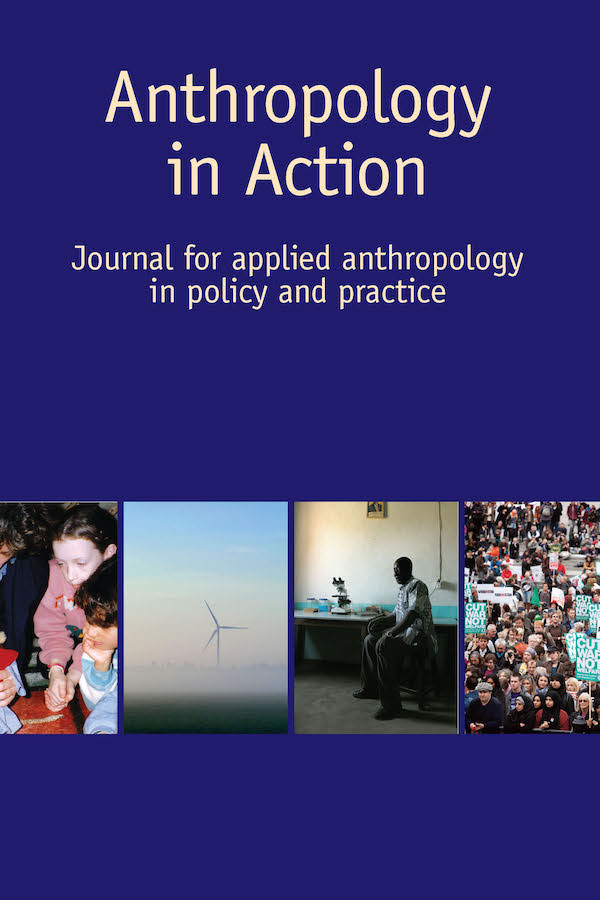
Anthropology in Action
Journal for Applied Anthropology in Policy and Practice
ISSN: 0967-201X (print) • ISSN: 1752-2285 (online) • 3 issues per year
Volume 30 Issue 2
Affective Cartographies of Collective Blame
Mediating Citizen–State Relations in Aotearoa/New Zealand and Australia during the COVID-19 Pandemic
In both Aotearoa/New Zealand and Australia, COVID-19 lockdowns were enforced through public scrutiny of the movements of supposedly ‘irresponsible’ individuals. Denouncing their impact on public health created an affective cartography of collective blame uniting State and society in shared moral indignation. Produced through assemblages of mainstream and social media and government statements, such mediated spectacles engendered a sense of collective unity and shared purpose at a time when both collective cohesion and narratives of individual responsibility were of particular interest to the State. Spatio-temporal maps and diagrams of culpable contagion helped materialise the invisible movement of the virus but also enabled identification of the sick. Some bodies more than others were made to carry the morality of the collective enterprise of stopping the virus.
The Role of Anthropology in India's Public Health
A Comparative Perspective with the USA and Europe
Conducting research on healthcare systems, policy implementation and the impact of health programmes can systematically identify the gaps and challenges in public health service delivery in India. Anthropology is particularly useful for so doing, but the role of anthropologists in health policy and planning needs recognition in India, as they can evaluate the effectiveness of interventions through a cultural lens, informing the development of evidence-based policies. The USA and Europe are more advanced in the use of anthropology in public health, due to their established academic programmes, robust research funding and infrastructure, and effective integration into public health institutions. Anthropological analysis and intervention has the capacity to improve Indian public health practice, particularly in terms of inclusivity and diversity issues.
Marginalised People's Access to Publicly Funded Abortion in Catalunya
A Follow-Up Assessment
Abortion has been legal in Catalunya for any reason in the first trimester and under a set of qualifying circumstances in the second since 2010 and integrated in the health system. Earlier studies identified disparities in access. Through rapid ethnographic assessment (REA) at a Barcelona clinic, this study sought to compare the findings of an earlier phase of REA previously published in this journal with subsequent data collection to determine continuity or changes in accessibility of publicly funded abortion. A subsequent REA found similarities in average wait times and numbers of visits to obtain the required voucher for a publicly funded abortion. Also persistent were greater delays for migrants. The greatest difference was participants with notably later average gestations when obtaining publicly funded abortions.
‘Anthropological Enough?’
Reflections on Methodology, Challenges of Doing Fieldwork ‘At Home’ and Building a More Inclusive Discipline
In this article, we discuss how fieldwork completed ‘at home’ in the USA presented challenges and resulted in our work being considered not ‘anthropological enough’. Centring our article around our individual projects for which primary data collection was completed prior to COVID-19, we explore a variety of issues related to methodology and structural constraints we experienced as graduate students in anthropology and now as junior scholars. Drawing on our experiences conducting research in the USA, we posit how anthropology might move forward in the wake of the COVID-19 pandemic and foster a more inclusive discipline. By challenging the notion of ‘anthropological enough’, we reimagine ways of conducting anthropology that are better suited for increasingly uncertain times, which call for collaborations rooted in social justice.
Doing Ethnography Blind
Anthropology's ‘mainstream’ research methods mainly rely on the visual sense. In contrast to sighted anthropologists, who mostly rely on their vision to acquire and process data, as a blind anthropologist I have used unconventional methodological sensory research techniques. I mostly rely on my senses of hearing and listening, using auditory means to make sense of people and our environment. Some of these auditory means are eavesdropping, understanding people's emotions through the tone of their voices and understanding the ‘acoustemology’ of spaces. I am highly attuned to the tones of people's voices and to the ambience of the places I am in. During my fieldwork, I was able to capitalise on these senses and abilities as research techniques, but also consider their ethical implications.