 Get New Issue Alerts
Browse Archive
- Vol 32 Issue 1
- Vol 31 Issue 3
- Vol 31 Issue 2
- Vol 31 Issue 1
- Vol 30 Issue 3
- Vol 30 Issue 2
- Vol 30 Issue 1
- Vol 29 Issue 3
- Vol 29 Issue 2
- Vol 29 Issue 1
- Vol 28 Issue 3
- Vol 28 Issue 2
- Vol 28 Issue 1
- Vol 27 Issue 3
- Vol 27 Issue 2
- Vol 27 Issue 1
- Vol 26 Issue 3
- Vol 26 Issue 2
- Vol 26 Issue 1
- Vol 25 Issue 3
- Vol 25 Issue 2
- Vol 25 Issue 1
- Vol 24 Issue 3
- Vol 24 Issue 2
- Vol 24 Issue 1
- Vol 23 Issue 3
- Vol 23 Issue 2
- Vol 23 Issue 1
- Vol 22 Issue 3
- Vol 22 Issue 2
- Vol 22 Issue 1
- Vol 21 Issue 3
- Vol 21 Issue 2
- Vol 21 Issue 1
- Vol 20 Issue 3
- Vol 20 Issue 2
- Vol 20 Issue 1
- Vol 19 Issue 3
- Vol 19 Issue 2
- Vol 19 Issue 1
- Vol 18 Issue 3
- Vol 18 Issue 2
- Vol 18 Issue 1
- Vol 17 Issue 2
- Vol 17 Issue 1
- Vol 16 Issue 3
- Vol 16 Issue 2
- Vol 16 Issue 1
- Vol 15 Issue 3
- Vol 15 Issue 2
- Vol 15 Issue 1
- Vol 14 Issue 3
- Vol 14 Issue 1
- Vol 13 Issue 3
- Vol 13 Issue 1
- Vol 12 Issue 3
- Vol 12 Issue 2
- Vol 12 Issue 1
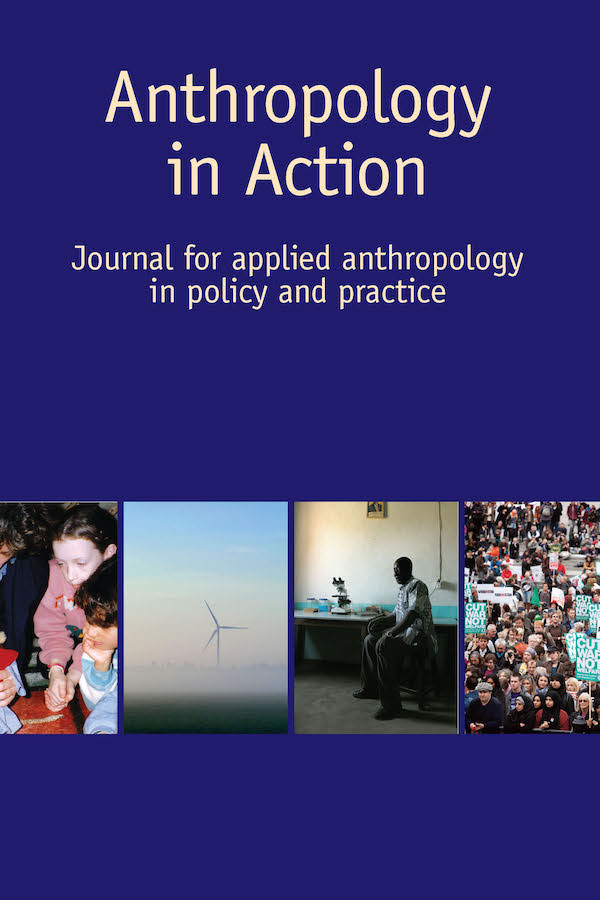
Anthropology in Action
Journal for Applied Anthropology in Policy and Practice
ISSN: 0967-201X (print) • ISSN: 1752-2285 (online) • 3 issues per year
Volume 17 Issue 2-3
Pathways to Anthropology
At the time of preparing this special double issue of Anthropology in Action, British anthropologists are debating the implications of current British government policy aimed at evaluating the influence of academic disciplines. One of the key functions of the Research Evaluation Framework (REF) is to measure the ‘impact’ of a subject-area’s activity, the extent to which it can be shown to have economic and social effects beyond the quoting circles of colleagues in print or at conferences. The merits or otherwise of the REF can be debated. Arguably, however, it misses one of the key areas where a subject such as anthropology can have a significant effect on the world: the teaching of its basic concepts, both in universities and in other contexts where cultural ‘relativism’ and the recognition of other legitimate ways of being in the world can gain purchase.
Home or Away?
Widening Participation and the Challenge for Anthropology
Drawing on recent ethnographic research with 'non-traditional' humanities and social science students at a 'new' university in the North West of England, this paper explores their contradictory experiences of alienation and engagement, and their attitudes to institutional 'Widening Participation' initiatives. It argues that these students' institutional survival depends on negotiating the conflicting expectations of their academic relationships and their day-to-day social responsibilities beyond the university.
What might these findings mean for anthropology's own pedagogic strategies? The paper ends by suggesting that a subject that asks its students fundamentally to question their established senses of self and 'home' may pose a further challenge for students for whom strained personal and domestic relationships, ambivalence and self-doubt are dominant motifs of their whole university experience.
Encountering Anthropology
An Exploratory Study of Degree Choice
Social anthropology in the U.K. is largely absent from the pre-university curriculum, contributing to the discipline's marginal status within higher education. My paper reports a small-scale empirical study of the transition to undergraduate anthropology as a socializing process that begins with the choice of discipline, continues as a learning experience and enables students to acquire elements of the discipline's 'culture'. The study identified 'chance' factors, serendipity and opportunism as important influences on choice of degree. These factors reflected the availability to applicants of cultural and economic capital. Students demonstrated varying degrees of socialization in identifying with anthropology's epistemological and social norms and values. My findings justify current attempts to increase the visibility of anthropology among pre-university students. They also support teaching initiatives that promote deep learning at undergraduate level. Both developments are necessary to sustain anthropology as a university discipline.
Grassroots Dedication and Opportunism
The Pre-university Anthropology Education Movement in the United States
To anyone who has taught anthropology to middle and high-school students in the United States, the discipline's value to intellectual and social development is undeniable. These educators are the engine of a small, long-lived movement to make anthropology a core part of the curriculum that students are exposed to during middle and high school, before they enter college or university. Despite valiant efforts and because of some very difficult challenges - (public misperception of the field, lack of institutional support, and the nature of the U.S. public education system) - the movement has not caught the momentum it needs to induce major changes. Nonetheless, new opportunities and some limited pockets of success offer good reasons to be cautiously optimistic. Rather than trying to compel entire school districts or education departments to adopt anthropology courses and standards, advocates are now focused on leveraging such opportunities to introduce as many educators and students as possible to anthropology.
From Enskillment to Houses of Learning
This article is an exploration of how the interdisciplinary relationship between art and anthropology can contribute to teaching anthropology in schools. The argument is made that through practical engagement with the environment - whether 'natural', social or built - one can develop important and complementary approaches to teaching and thinking about anthropology. Three specific areas of activity are examined: skill and practical work with materials, doing children's ethnographies and 'playing house'. The author draws upon her own experience of working both as an artist and an anthropologist.
Anthropology and the International Baccalaureate
History, Practice and Future Challenges
The article contextualizes the educational, political and social context in which the International Baccalaureate (IB) diploma programme was established and describes the place of social anthropology within the general aims of the diploma programme as a whole. The article then discusses the current diploma curriculum for social and cultural anthropology and the issues arising from this for the teaching and learning of anthropology in a global context, including teacher support and comparisons with other national pre-university educational qualifications. Some of the perceptions of the IB diploma among teachers, students and parents are also briefly discussed.
Anthropology, Education and the Wider Public
The article addresses the position of anthropology in new educational contexts, considering anthropology in education and the anthropological study of education. While some transatlantic comparisons are drawn, the emphasis is on developments within the U.K. These are treated historically, using the Royal Anthropological Institute's experience in working for an anthropological presence in pre-university education from the 1980s to the present as an extended case-study. The work done by the RAI's Education Committee to design and introduce a new GCE A-level in anthropology, culminating in its successful accreditation by the national regulator, is recounted in the style of 'rich ethnography'. A case is made for the potential of academic associations to create the alliances across sectors that are needed in this context; and conclusions are tentatively drawn regarding the implications of these initiatives for the future of the discipline and its public engagement.
Culture, Identity, Difference
Developing a Museum-based Anthropology Education Resource forPre-university Students
In its 2002-3 Strategic Review, the Royal Anthropological Institute reasserted the importance of the public communication of anthropology for the future of the discipline. Two significant venues for public engagement activity were identified: museums and pre-university education contexts. We present an account of the development and piloting of an anthropology teaching and learning resource that bridges these two arenas. Complementing efforts to introduce an anthropology A-Level, the Culture, Identity, Difference resource uses museum collections as a way of introducing anthropological perspectives on topics such as belief, ethnicity, gender and power to enhance students' studies across a range of different A-Level subjects. We reflect on some of the lessons learnt during the process, including the value of developing resources that can be used flexibly and creatively by teachers and students, and the need to approach the museum as a space of encounter, exploration and experimentation rather than as a didactic educational venue.
A Good Straight Road
Reflections on the Development of Pre-university Anthropology in the U.K.
The articles assembled in this collection provide a timely focus upon a critical issue for the reproduction of anthropology as an institutionalized form of knowledge in the U.K. and more widely. Simply stated, the problem they identify is as follows: anthropology is a relatively small discipline with low visibility beyond the sites in the academy where it is taught and where research is carried out; there are currently significant threats to the future of anthropology as practised within British higher education and in other countries too (e.g. in terms of its funding, sustainability, perceptions of relevance, the current nature of evaluation and audit); one of the main areas of vulnerability, in this regard, is the recruitment of new generations of students into the discipline, which is variable and volatile across the sector; and, finally, a significant factor here is the virtual absence of anthropology in curricula at pre-university level, particularly in the U.K. In addition, the papers show a strong conviction that anthropology has something valuable and engaging to off er at this level and into employment possibilities beyond.
Book Reviews
Ethnography and the Corporate Encounter: Reflections on Research in and of Corporations. Melissa Cefkin (ed.), Oxford and New York: Berghahn, 2009, ISBN 978-1-84545-598-9 (Hardback) ISBN 978-1-84545-777-8 (Paperback) 262 pp. Hb £50.00 Pb £21.00
Engaging Contradictions: Theory, Politics and Methods of Activist Scholarship. Charles R. Hale (ed.), Berkeley: University of California Press, 2008, ISBN: 978-0-520-09861-9 (Paperback Only) 417 pp. £24.95
The Anthropology of Organizations. Alberto Corsín Jiménez (ed.), Aldershot: Ashgate, 2007, ISBN: 978-0-7546-2595-7 (hardback only) 600 pp. £165.00
State, Communities and Forests in Contemporary Borneo. Fadzilah Majid Cooke (ed.), Canberra: Australian National University Press, 2006, ISBN 1-9209425-1-3 (Print Version) 208 pp.
The Nomads of Mykonos: Performing Liminalities in a ‘Queer’ Space. Pola Bousiou, New York and Oxford: Berghahn Books, 2008, 322 pages, Paperback £15.95, ISBN: 978-1-84545-426-5
Books for Review
Anthropology in Action is always happy to hear from potential reviewers at all stages in their academic careers. Reviews are normally short – about 500 words – but a more in-depth review can also be planned if you wish. We currently have a number of books awaiting review. If you are interested in reviewing any of the books on the list below, please feel free to get in touch. Alternatively, if there is a particular book you would like us to request please contact Michaela Benson (M.Benson@bristol.ac.uk)