 Get New Issue Alerts
Browse Archive
- Vol 16 Issue 1
- Vol 15 Issue 1
- Vol 14 Issue 1
- Vol 13 Issue 1
- Vol 12 Issue 1
- Vol 11 Issue 1
- Vol 10 Issue 1
- Vol 9 Issue 1
- Vol 8 Issue 1
- Vol 7 Issue 1
- Vol 6 Issue 1
- Vol 5 Issue 1
- Vol 4 Issue 1
- Vol 3 Issue 1
- Vol 2 Issue 1
- Vol 1 Issue 1
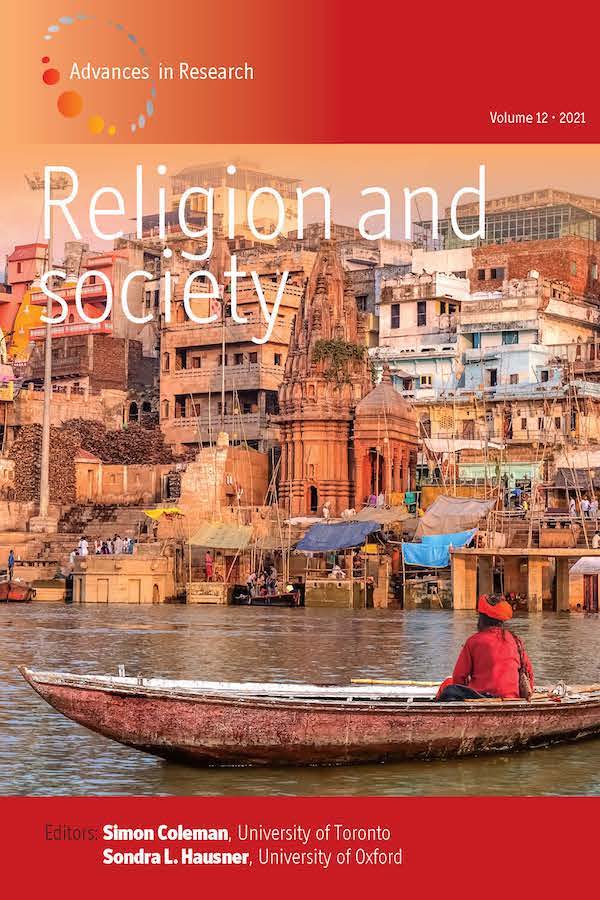
Religion and Society
Advances in Research
ISSN: 2150-9298 (print) • ISSN: 2150-9301 (online) • 1 issues per year
Volume 6 Issue 1
Introduction
The Borders of Religion
This volume of Religion and Society is marked by borders, boundaries, and limits. The borders here are those that make religion operative and politically powerful, as well as those that are enabled and put into place by religious arguments and worldviews. All these dimensions of borders are included in the special section of this volume, coordinated by Valentina Napolitano and Nurit Stadler, entitled “Borderlands and Religion: Materialities, Histories, and the Spatialization of State Sovereignty.” The section includes articles by Alejandro Lugo, Nurit Stadler and Nimrod Luz, Alberto Hernández and Amalia Campos-Delgado, and Alexander D. M. Henley. They dwell upon two of the most notorious and contentious borders in the world: the one that separates Lebanon and Palestine from Israel, and the one that separates the US from Mexico. Both Israel and the US are known for their fenced and walled frontier politics. From these contributions, we learn how borderlands and their religious framing become spaces of political negotiation by affirmation and/or by exclusion: they determine sovereignty, ontology, history.
Portrait
Ann Taves
As the first invitee to this portrait section trained as a scholar of religion and situated in a department of religious studies, I was interested to see how previous scholars trained in anthropology and sociology positioned themselves in relation to ‘religion’ as an object of study. It seems we all do so gingerly. Although my graduate work was in the history of Christianity with a focus on American religious history, since the early 1990s I have self-consciously positioned my historical research in an interdisciplinary space between psychiatry, anthropology, and religious studies in order to explore the contestations surrounding unusual experiences. During the last decade, I have been identifying myself less as a historian and more as an interdisciplinary scholar attempting to bring both humanistic and cognitive social scientific methods to the study of historical experiences and events. From this vantage point, I would argue, as Maurice Bloch (2010) did in the first volume of this journal, that ‘religion’ is not a natural kind but a complex cultural concept and that a theory of religion per se is impossible.
Other Times, Other Worlds
Archaeology, Ritual, and Religion
This article is an introduction to the emerging sub-discipline of the archaeology of ritual and religion. It addresses the question of how archaeologists can approach these fields: what are the challenges and opportunities? Using theory and methodology, ritual and religion are explored in the archaeological record by means of so-called framing, and an interpretation is attempted through analogy and 'ethos'. Selected Neolithic sites from the Near East that have yielded rich and important data regarding ritual and religion serve as examples.
Cosmogony Today
Counter-Cosmogony, Perspectivism, and the Return of Anti-biblical Polemic
In this article I review critical thought about cosmogony in the social sciences and explore the current status of this concept. The latter agenda entails three components. First, I argue that, even where cosmogony is not mentioned, contemporary anthropological projects that reject the essentialist ontology they ascribe to Western modernity in favor of analytical versions of relational non-dualism thereby posit a 'counter-cosmogony' of eternal relational becoming. Second, I show how Viveiros de Castro has made Amazonian cosmogonic myth—understood as counter-cosmogony—iconic of the relational non-dualist ontology he terms 'perspectival multinaturalism'. Observing that this counter-cosmogony now stands in opposition to biblical cosmogony, I conclude by considering the consequences for the study of cosmogony when it becomes a register of what it is about—when it becomes, that is, a form of polemical debate about competing models of cosmogony and the practical implications that they are perceived to entail.
The Anthropology of Secularity beyond Secularism
This article begins by exploring why secular studies may be stagnating in anthropology. Contrary to recent arguments, I maintain that rather than widening the definition of secularism to address this, we should shift our focus, if only slightly. While secularism remains a worthy object, foregrounding it risks tying the field to issues of governance. I therefore suggest avoiding language that privileges it. Moreover, in returning to Talal Asad's 'secular', it becomes evident that care should be taken with the notion of 'secularism' to begin with, even if he did not emphasize this analytically. Conceiving of secularism as a transcendent political power, as Asad does, is not only a critique of a secularist narrative, but also a secularist truism itself that can potentially cloud ethnography if applied too readily. A way forward lies in carefully attending to secular concepts, as Asad suggests, and in exploring a version of secularity inspired by the work of Charles Taylor.
Glossolalia and Linguistic Alterity
The Ontology of Ineffable Speech
This article proposes a revised definition of glossolalia based on the ritual value of incomprehensible speech, which allows for an approach to meaning emergence in non-human languages and the issue of extreme linguistic alterity. The main social and acoustic features associated with glossolalia will be presented through the case study of a Christian charismatic community in Brazil (the Canção Nova), showing us how linguistic evidence supports different notions of Christian personhood and an iconic-based communication between human and divine beings.
Introduction
Materialities, Histories, and the Spatialization of State Sovereignty
In the introduction to this special section of Religion and Society, we discuss existing and potentially new intersections of border theories and religious studies in relation to two contested regions—US-Mexico and Israel-Palestine (as part of the history of the Levant)—respectively. We argue for a recentering of borderland studies through an analysis of political theologies, affective labor, and differing configurations of religious heritage, traces, and materiality. We thus define 'borderlands' as translocal phenomena that emerge due to situated political/economic and affective junctures and that amplify not only translocal but also transnational prisms. To explore these issues, we put into dialogue studies on religion, borderlands, walls, and historical/contemporary conditions in the context of US-Mexico and Israel-Palestine borders. In particular, we argue for recentering analyses in light of intensifications of state control and growing militarization in contested areas.
Occupation, Religion, and the Voidable Politics of Empire at the US-Mexico Border
Following Ann Stoler's analysis of 'imperial debris' and Gastón Gordillo's notion of the 'void', this article examines how, in the context of the Mexican-American War of 1846–1848, imperial and religious impulses have endured from the mid-nineteenth century to the present at the US-Mexico border. Using photographs taken at different 'sites of memory' located along the 60-mile corridor that connects Las Cruces, New Mexico, with El Paso, Texas, this analysis demonstrates that the continuing American occupation of Mexican lands has contributed to the oblique inclusion and parallel exclusion or erasure of the historical presence of the Mexican community, as well as its political, cultural, and historical legitimacy in the region. However, the essay argues that ultimately the 'voidable' status of the American presence in the US-Mexico border region continues to reproduce itself. The article closes with a series of photographs of churches that capture religious landscapes that manifest, challenge, and transcend the occupied borderlands through the materiality of their presence.
Two Venerated Mothers Separated by a Wall
Iconic Spaces, Territoriality, and Borders in Israel-Palestine
This article explores the role of sacred places and pilgrimage centers in the context of contemporary geopolitical strife and border disputes. Following and expanding on the growing body of literature engaged with the contested nature of the sacred, this article argues that sacred sites are becoming more influential in processes of determining physical borders. We scrutinize this phenomenon through the prism of a small parcel of land on the two sides of the Separation Wall that is being constructed between Israel and Palestine. Our analysis focuses on two holy shrines that are dedicated to devotional mothers: the traditional Tomb of Rachel the Matriarch on the way to Bethlehem and Our Lady of the Wall, an emergent Christian site constructed as a reaction to the Wall. We examine the architectural (and material) phenomenology, the experience, and the implications that characterize these two adjacent spatialities, showing how these sites are being used as political tools by various actors to challenge the political, social, and geographical order.
Saints and Virgins
Religious Pluralism in the City of Tijuana
A double referent connoting both movement and immobility, the border region has been, for more than a century, the setting for those who come to stay, those who try to cross over into the United States, and, more recently, those who are deported from the US. Accordingly, the religious practices in this area flow along with the shifting populations and are transformed by them. From a socio-anthropological perspective, this article examines the main religious figures venerated in the city of Tijuana, located just south of the US-Mexico border, and the social contexts of their devotees, who have come from other parts of Mexico. This religious panorama does not display a homogeneous group of creeds, but rather reflects a variety of regional traditions in which religion is practiced and divine figures are revered.
Remaking the Mosaic
Religious Leaders and Secular Borders in the Colonial Levant
The colonial view of Levantine society as a mosaic of religions established lasting precedents for communal self-governance and power sharing in modern states. Yet it ironically disguises the extent to which the region's religious geography was reimagined by colonial rule. Principles of religious freedom and minority rights combined with a perception of 'oriental religions' to create a unique and powerful place for religious leaders to govern. The borders that would define national societies in Palestine-Israel, Lebanon, and Syria also remade the boundaries by which the religious mosaic was structured. This article will highlight institutional change in the Maronite Christian and Sunni Muslim communities, showing how each reformulated its religious leadership in response to the creation and enforcement of Lebanon's borders with Palestine and Syria from 1920 to 1948. The 'traditional' religious leaderships of today are in no small part products of the same colonial 'lines in the sand' within which nations were formed.
Debate
In Response to Charlie
There is a close relation between satire and secularism as the latter came to emerge in Europe. Secularism, as is well-known, gained strength historically as a reaction to an era of European interreligious violence and massacres. It was not only a desire for the separation of church and state, as the classical formula has it. It was also an attempt to keep religious affect out of politics. This was in the belief that religion, because it is faith rather than reasoned thinking, produces too much of a narcissistic affect—that the faithful are unable to ‘keep their distance’ from what they believe in. It was thought that this narcissism was behind the murderous intensity of religiously driven conflicts. Being able to laugh at yourself literally means being able to not take yourself overly seriously. This, in turn, is crucial for the deintensification of the affects generated by the defense of what one believes in and for the relativization of one’s personal beliefs. Such relativization, as Claude Lévi- Strauss argued, is crucial for thinking oneself comparatively and in relation to others (the opposite of narcissism).
News
“Ashgate Studies in Pilgrimage” Series
New Book Series: “Religious Engagement in Democratic Politics”
Website for New Books in Religion
Book Reviews
ABRAMS, Andrea C., God and Blackness: Race, Gender, and Identity in a Middle Class Afrocentric Church, 195 pp., references, index. New York: New York University Press, 2014. Paperback, $26. ISBN 9780814705247.
CHRISTENSEN, Jeanne, Rastafari Reasoning and the RastaWoman: Gender Constructions in the Shaping of Rastafari Livity, 202 pp., bibliography, index. Lanham, MD: Lexington Books, 2014. Hardback, $80. ISBN 9780739175736.
COX, James L., The Invention of God in Indigenous Societies, 192 pp., notes, bibliography, index. Durham: Acumen, 2014. Paperback, $ 31. ISBN 9780520280472.
DAWSON, Andrew, Santo Daime: A New World Religion, 240 pp., notes, bibliography, index. New York: Bloomsbury Academic, 2013. Paperback, $40. ISBN 9781441154248.
DESCOLA, Philippe, Beyond Nature and Culture, trans. Janet Lloyd, 488 pp., notes, bibliography, index. Chicago: University of Chicago Press, 2013. Hardback, $52. ISBN 9780226144450.
FLORES, Edward Orozco, God’s Gangs: Barrio Ministry, Masculinity, and Gang Recovery, 243 pp., notes, references, index. New York: New York University Press, 2013. Paperback, $22. ISBN 9781479878123.
GESCHIERE, Peter, God’s Witchcraft, Intimacy and Trust: Africa in Comparison, 243 pp., notes, references, index. 328 pp., notes, references, index. Chicago: University of Chicago Press, 2013. Hardback, $75. ISBN 9780226047584.
Johnson, Paul Christopher, ed., Spirited Things: The Work of “Possession” in Afro-Atlantic Religions, 344 pp., notes, bibliography, index. Chicago: University of Chicago Press, 2014. Hardback, $97.50. ISBN 9780226122625.
KLASSEN, Pamela E., Spirits of Protestantism: Medicine, Healing, and Liberal Christianity, 348 pp., notes, bibliography, index. Berkeley: University of California Press, 2011. Paperback, $29.95. ISBN 9780520270992.
KOHN, Eduardo, How Forests Think: Toward an Anthropology Beyond the Human, 288 pp., notes, bibliography, index. Berkeley: University of California Press, 2013. Paperback, $29.95. ISBN 9780520276116.
LUHRMANN, T. M., When God Talks Back: Understanding the American Evangelical Relationship with God, 464 pp., notes, bibliographic notes, bibliography, index. New York: Vintage Books, 2012. Paperback, $20. ISBN 9780307277275.
RAMSEY, Kate, The Spirits and the Law: Vodou and Power in Haiti, 448 pp., illustrations, maps, notes, bibliography, index. Chicago: University of Chicago Press, 2011. Hardback, $50. ISBN 9780226703794.