 Get New Issue Alerts
Browse Archive
- Vol 16 Issue 1
- Vol 15 Issue 1
- Vol 14 Issue 1
- Vol 13 Issue 1
- Vol 12 Issue 1
- Vol 11 Issue 1
- Vol 10 Issue 1
- Vol 9 Issue 1
- Vol 8 Issue 1
- Vol 7 Issue 1
- Vol 6 Issue 1
- Vol 5 Issue 1
- Vol 4 Issue 1
- Vol 3 Issue 1
- Vol 2 Issue 1
- Vol 1 Issue 1
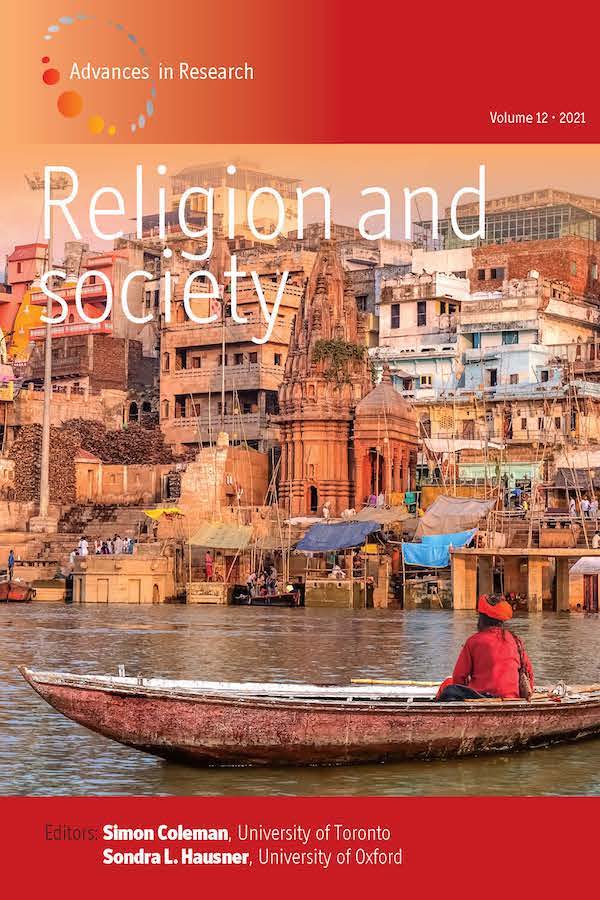
Religion and Society
Advances in Research
ISSN: 2150-9298 (print) • ISSN: 2150-9301 (online) • 1 issues per year
Volume 5 Issue 1
Introduction
Authority, Aesthetics, and the Wisdom of Foolishness
With characteristic playfulness, the subject of this volume’s portrait, Gananath Obeyesekere, calls his contribution a celebration of ‘foolishness’. But this is indeed a fertile foolishness. It implies not only an admission that the ethnographer lacks omniscience, but also a positive freedom to engage passionately in comparison, to avoid disciplinary overspecialization, to understand that the “non-rational is not necessarily irrational,” and to acknowledge the power of art and literature as potential inspirations for our work. Of course, as Obeyesekere admits, the ludic and the ironic also entail risks, as they can provoke anger in others. Nonetheless, his words have many echoes in this volume, particularly in their invocation of the power of the aesthetic combined with the ironic, exemplified by reference to the fool in Shakespeare’s Twelfth Night. They also provoke thoughtful reflections from our three commentators on Obeyesekere’s work, Douglas Hollan, Luís Quintais, and Unni Wikan.
Portrait
Gananath Obeyesekere
In my most recent book, The Awakened Ones: Phenomenology of Visionary Experience (2012), I end my wandering mind with mention of my own anticipated end—a farewell, as it were, to an overlong life, much of it devoted to scholarly work on the study of religion in practice. However, I find it hard to divorce practice from a sympathetic understanding that some of us natives think of as Buddhism, for example. As for me, I would like to open our ethnographies and histories to the multiple ways in which we write and to celebrate our work and praise our foolishness, for none of us are omniscient and foolishness is part of our work and our species’ sentience. In much of my work I also celebrate comparison because for me it is hard to accept that as thinking beings we have to confine our thought to some narrow sphere.
The 'Orthodoxy' of Orthodoxy
On Moral Imperfection, Correctness, and Deferral in Religious Worlds
This article uses ethnographic studies of Orthodox Christianities as a way to investigate the concept of 'orthodoxy' as it applies to religious worlds. Orthodoxy, we argue, is to be found neither in opposition to popular religion nor solely in institutional churches, but in a set of encompassing relations among clergy and lay people that amounts to a religious world and a shared tradition. These relations are characterized by correctness and deferral—formal modes of relating to authority that are open-ended and non-definitive and so create room for certain kinds of pluralism, heterodoxy, and dissent within an overarching structure of faith and obedience. Attention to the aesthetics of orthodox practice shows how these relations are conditioned in multi-sensory, often non-linguistic ways. Consideration of the national and territorial aspects of Orthodoxy shows how these religious worlds of faith and deferral are also political worlds.
The Precarious Center
Religious Leadership among African Christians
This article addresses a long-standing conundrum in the anthropology of religion concerning the ambiguous status of religious leaders: they are subjects of power in that they are able to exert power over others, yet they are objects of power in that they rely on empowerment through others. Taking African-initiated Pentecostal-charismatic Christianity in Zambia as my example, I argue that church leaders' strategies to stabilize their authority have unintended consequences since these strategies can contribute to the precariousness of their positions. By drawing fundamental distinctions between themselves and members of the laity as regards their own extraordinariness, church leaders raise high expectations about their own capacities that may turn out to be impossible to fulfill. Yet even the opposite strategy of strengthening one's authority by embedding oneself in socio-religious networks can eventually lead to a destabilization of church leaders' authority because it increases their dependence on factors that are beyond their control.
“Aren't You Looking for Citizenship in the Wrong Place?”
Islamic Education, Secularities, and the Portuguese Muslim
This article examines the relation between secularities, technologies of the self, and citizenship through an ethnography of Islamic education in Portugal. For the Islamic Community of Lisbon, the main institutional representative of Islam in Portugal, religious education is about the formation of religious subjects and the creation of embodied dispositions in relation to Islam. But it is also about being able to explain to others, Muslims and non-Muslims alike, what Islam is. This project for Islamic education has to be understood, I will argue, in the context of the production of a public Islam, secularized and liberal, that is tied to claims to citizenship made in Portuguese society for more than 60 years. While these discursive formations are partly a way to counteract stigma, it is also essential to understand them within the creation of a post-confessional Portuguese society. For members of the Islamic Community of Lisbon, supporting a project of secularization of the public sphere in such a historical context is a way to affirm their belonging.
The Ecology of Images
Seeing and the Study of Religion
Opening with a review of leading accounts of the image as an object with agency, this article proposes to study religious images within the webs or networks that endow them with agency. The example of a well-known medieval reliquary serves to show how what I refer to as 'focal objects' participate in the creation of assemblages that engage human and non-human actors in the social construction of the sacred. Focal objects are nodal points that act as interfaces with the network, particularly with invisible agents within it. As participants in a network, images are like masks, offering access to what looks through the mask at viewers engaged in a complex of relations that constructs a visual field or the ecology of an image.
Introduction
Contested Narratives of Storied Places—the Holy Lands
The articles in this special section on pilgrimage and the Holy Lands provide a wide range of perspectives on the practice, representation, and production of sacred space as expressions of knowledge and power. The experience of space of the pilgrim and the politically committed tourist is characterized by distance, impermanence, desire, contestation, and the entwinement of the material and the spiritual. The wealth of historical Christian and Western narratives/images of the Holy Land, the short duration of pilgrimage, the encounter with otherness, the entextualization of sites, and the semiotic nature of tourism all open a gap between the perceptions of pilgrims and those of 'natives'. Although the intertwining of symbolic condensation, legitimation, and power makes these Holy Land sites extremely volatile, many pilgrimages sidestep confrontation with the Israeli-Palestinian conflict as inimical to the spirit of pilgrimage. A comparative view of the practices of contemporary Holy Land pilgrims demonstrates how communitas and conflict, openness and isolation are constantly being negotiated.
Guiding Settler Jerusalem
Voice and the Transpositions of History in Religious Zionist Pilgrimage
This article examines how Elad, a religious Zionist settler group, attempts to reanimate biblical tales by transposing biblical text as part of tours for Jewish visitors to the City of David archaeological site in East Jerusalem. Since the early 1990s, Elad has created controversy by settling in the Palestinian neighborhood of Silwan, provoking criticism from Israeli archaeologists and peace activists. In an effort to avoid 'politics' during tours, the group emphasizes a now globalized historicist reading of the Bible, an interpretation popularized by archaeology over the last century and a half. The article considers how transposition from this historicist reading into the here and now is a rhetorical device used to create a biblical realism that does not yet exist in the contested landscape. However, rather than producing an erasure of the Palestinian presence, and in contradiction to the professed desire to refrain from politics, I show that the very communicative situation and multiple framings for producing this biblical realism inevitably remind visitors of the contemporary context.
Changing Colors of Money
Tips, Commissions, and Ritual in Christian Pilgrimage to the Holy Land
The movement of money in Christian pilgrimage is a profound mirror of cultural classifications. By examining tips, commissions, and souvenir purchases in Holy Land pilgrimages, I show how the transfer of monies activates a series of multiple, complex relationships between Jewish guides, Palestinian drivers, and Christian pilgrims. I identify the 'colors'—or moral values—of salaries, tips, and commissions that change hands as 'white', 'black', or 'gray' monies and correlate these colors with particular discourses and degrees of transparency. I then illustrate how prayer, rituals, and the citation of scripture may 'bleach' these monies, transforming tips into 'love offerings' and souvenir purchases into aids to spiritual development or charity to local communities, while fostering relationships and conveying messages across religious and cultural lines. Far from being a universal 'acid' that taints human relationships, pilgrimage monies demonstrate how, through the exchange of goods, people are able to create and maintain spiritual values.
Age of Innocence
The Symbolic Child and Political Conflict on American Holy Land Pilgrimage
The link between US evangelicalism, Zionism, and Middle East policy is well documented, as is its refraction through Christian tourism/pilgrimage in Israel-Palestine. However, the scholarly focus on political Zionism oversimplifies how American Christian pilgrims, mostly older women, actually construe the experience: they see contemporary politics as unrelated, and even antithetical, to the trip's spiritual goals. Building on Liisa Malkki's notion of 'tranquilizing' symbols, this article shows how pilgrims draw on broadly moral cultural tropes to quell political discussions, while still speaking in a moral register about Israelis and Palestinians. It explores how one especially powerful trope—the 'symbolic child'—is deployed during the trip. Tracing this image historically and ethnographically, I argue that pilgrims ground their reactions to Israeli-Palestinian conflict in symbolism with deep resonance for American women, which also speaks to how they engage in politics at home.
The 'Empty Tomb' as Metaphor
Finding Comfort in Nothingness
This article considers the ways in which Roman Catholic pilgrims on a tour in the Holy Land reacted to displays of emotion, exposing both the fragility and the strength of a religious community struggling with uncertainties concerning belief and practice. Participants focused on a reading of the biblical gospel that, in its original form, omitted the story of Christ's resurrection. The pilgrims were encouraged to identify themselves with the earliest Christians confronted by an empty tomb and to explore the lessons in Mark's gospel for a community of Christians in crisis. The 'empty tomb' is read here as a metaphor for the 'limits of meaning', found in all practices of interpretation, whether exegetical or anthropological. Attention is focused on how various actors responded to each other and to a place, the Holy Land, which challenges the interpretive skills of most, particularly those encouraged to remain open and respectful of the stories and religious traditions of others.
The Accidental Pilgrims
Olive Pickers in Palestine
This article focuses on the way in which olive-picking volunteers in Palestine become transformed into 'accidental pilgrims', and unconventional ones at that, by virtue of their participation in the olive harvest. Undergoing the difficulties of mobility that constrain the Palestinians and witnessing holy sites through the eyes and narratives of Palestinian guides, they are exposed to an alternative knowledge and affect regarding the Holy Land, unlike the experience offered by more conventional religious pilgrimage. Several vignettes reflect the diverse backgrounds of olive-picking pilgrims, who come from many different religions, class positions, and nationalities. Drawn together in a communitas of sorts through their shared commitment to learning about Palestine, they try to do what they can to further the Palestinian cause on their return home. Instead of a 'moral geography', they perceive a profoundly 'immoral geography' of occupation and oppression, which has a powerful transformative effect.
Afterword
The articles in this special section focus on diverse groups of pilgrims, with each group expressing a different perspective on the Holy Land. Perhaps it would be more appropriate to state that each of these groups, together with their guides, constructs a different Holy Land, resulting in multiple Holy Lands. What exactly is it that makes a land holy? I suggest that we view religion as a social and individual endeavor to interpret experience in ways that are perceived to be meaningful, and as an effort to overcome the isolation of the self through connections with persons, values, and communities that are perceived to elevate, empower, and transcend the individual. From this perspective, places—lands—become holy through their associations with such overarching ‘imagined communities’ (Anderson 1983). Conflict has the potential to arise when the same geographic space is symbolically central for more than one such community. The articles in this section evoke the contestation of meanings as Christians—both Catholic and Protestant—as well as Jews and Muslims visit and dwell within the same territorial space, considered by all, for different reasons, to be ‘holy’.
An Author Meets Her Critics
Around Birgit Meyer’s "Mediation and the Genesis of Presence: Toward a Material Approach to Religion"
In the fall of 2011, I was appointed to the Chair of Religious Studies in the Department of Religious Studies and Theology in the Faculty of Humanities. As I soon realized, my appointment occurred amid major transitions regarding the institutionalization of the study of religion at Utrecht University. This is part of a broader trend of renegotiating the space between ‘theology’ and ‘religious studies’. This trend echoes a wider process of ‘unchurching’: as the number of students of theology declines nationwide, religion in new and unexpected guises has become both a hot item and an intriguing socio-cultural and political phenomenon. Over the past year, as part of the process of adapting to my new post, I have grappled with these complicated institutional transformations.
The Anthropology of Christianity Goes to Seminary
“I didn’t know that we were the repugnant other,” my student Tracy exclaimed as she entered the classroom and tossed her books on the table. “I didn’t know that anthropologists were interested in studying us at all!” “Yes, I imagine it comes as a surprise,” I responded as I finished moving the classroom desks into a semi-circle that was intended to facilitate the creation of spaces marked by open dialogue and diversity—core pedagogical concerns of the institution at which I was teaching. It was the second day of class, and Tracy’s comments were in response to Joel Robbins’s (2003) article “What Is a Christian? Notes toward an Anthropology of Christianity.” His discussion of Susan Harding’s infamous ‘repugnant cultural other’, which Robbins describes as an “anomalous mixture of the similar and the different” (ibid.: 193), had hit a nerve. Tracy’s question about anthropological interests in the Christian subject was an expected one, given that I was leading a special topics seminar on the Anthropology of Christianity to master of divinity students at the Candler School of Theology, a United Methodist seminary affiliated with Emory University in Atlanta, Georgia.
Book Reviews
SHULTS, F. LeRon, Iconoclastic Theology: Gilles Deleuze and the Secretion of Atheism, 242 pp., illustrations, index. Edinburgh: Edinburgh University Press, 2014. Hardback, $104. ISBN 9780748684137.
BARBER, Daniel Colucciello, Deleuze and the Naming of God: Post-secularism and the Future of Immanence, 232 pp., index. Edinburgh: Edinburgh University Press, 2014. Hardback, $113. ISBN 9780748686360.
DROEBER, Julia, The Dynamics of Coexistence in the Middle East: Negotiating Boundaries Between Christians, Muslims, Jews and Samaritans in Palestine, 256 pp., notes, bibliography, index. London: I.B. Tauris, 2013. Hardback, £58.00. ISBN 9781780765273.
ENGELKE, Matthew, God’s Agents: Biblical Publicity in Contemporary England, 320 pp., notes, references, index. Berkeley: University of California Press, 2013. Paperback, $34.95, £24.95. ISBN 9780520280472.
FAUSTO, Carlos, Warfare and Shamanism in Amazonia, 368 pp., illustrations, maps, tables, references, annex, index. Cambridge: Cambridge University Press, 2012. Hardback, £62. ISBN 9781107020061.
HARVEY, Graham, Food, Sex and Strangers: Understanding Religion as Everyday Life, 244 pp. Durham: Acumen, 2013. Paperback, $23. ISBN 9781844656936.
NYNÄS, Peter, and Andrew Kam-Tuck YIP, eds., Religion, Gender and Sexuality in Everyday Life, 173 pp., index. Farnham: Ashgate, 2012. Hardback, £45. ISBN 9781409445838.
PALMIÉ, Stephan, The Cooking of History: How Not to Study Afro-Cuban Religion, 360 pp., notes, references, index. Chicago: University of Chicago Press, 2013. Cloth, $85. ISBN 9780226019420.
SEALES, Chad E., The Secular Spectacle: Performing Religion in a Southern Town, 238 pp., illustrations, notes, index. New York: Oxford University Press, 2013. Paperback, $24.95. ISBN 9780199860289.
SELBY, Jennifer A., Questioning French Secularism: Gender Politics and Islam in a Parisian Suburb, 241 pp., illustrations, appendix, notes, bibliography, index. New York: Palgrave Macmillan, 2012. Hardcover, $73. ISBN 9780230121010.
TOMLINSON, Matt, and Debra MCDOUGALL, eds., Christian Politics in Oceania, 260 pp., illustrations, maps, bibliography, index. New York: Berghahn Books, 2013. Hardback, $90. ISBN 9780857457462.